September 2026

Answer Engine Optimization - Recro
Blog

What Is Answer Engine Optimization (AEO)? How Businesses Can Get Discovered Beyond Traditional Search

Search is no longer limited to a list of blue links. People increasingly expect search engines to understand complete questions, compare information and provide direct answers. Google’s search experience now includes AI Overviews and AI Mode, alongside traditional results and other search formats. Google has also published specific guidance for websites seeking visibility in generative AI features. This shift has brought Answer Engine Optimization (AEO) into the digital marketing conversation. But AEO is often misunderstood. It is not a secret formula for making a business appear in every AI-generated answer. Instead, it is better understood as an approach to structuring and creating useful information so that answer-oriented search experiences can understand, interpret and potentially surface it. For businesses, that means thinking beyond simply ranking for keywords. What Is Answer Engine Optimization? So, what is AEO in digital marketing? Broadly, Answer Engine Optimization refers to the practice of creating and structuring content so it can effectively answer the questions people ask through search and answer-oriented systems. Traditional SEO often focuses on helping pages become discoverable and relevant for searches. AEO places additional emphasis on clear questions, direct answers, context and information that genuinely satisfies a user’s intent. The two approaches are not competitors. In fact, Google’s current guidance for generative AI features explicitly states that traditional SEO fundamentals remain relevant. Google also says there are no additional technical requirements or special schema specifically required for appearing in AI Overviews or AI Mode. Why Does AEO Matter for Businesses? Imagine someone searching: “What should a small business look for when choosing a digital marketing agency?” A page that simply repeats the phrase “digital marketing agency” dozens of times is unlikely to provide much value. A useful resource could explain what businesses should evaluate, how to compare services, which questions to ask an agency and what warning signs to consider. That difference matters because modern search is increasingly concerned with understanding information and connecting users with useful sources. Google’s 2026 guidance on generative AI specifically highlights the importance of non-commodity content, information that offers genuine value rather than simply reproducing what is already available elsewhere. For businesses exploring AEO services, the focus should therefore be on creating information that genuinely helps users rather than trying to manipulate how answer systems respond. AEO Starts With Understanding Questions One of the most practical ways to approach AEO is to understand the questions your audience actually asks. These might include: These questions can inform articles, service pages, FAQs, guides and other useful resources. The objective is not to create a separate page for every imaginable question. It is to build authoritative resources that answer related questions comprehensively. Make Answers Clear and Specific Answer-oriented content benefits from clarity. If a page discusses a question, the answer should not be buried beneath several paragraphs of generic introduction. A useful structure might be: Question → Direct answer → Explanation → Supporting details → Practical example This makes information easier for readers to navigate and gives search systems clearer contextual signals. However, clarity should not become oversimplification. Complex subjects still require nuance, qualifications and supporting explanation. An AEO agency can help businesses structure this information around real user questions while keeping the content useful and natural for human readers. Build Genuine Topical Authority A business should not rely on one article to establish expertise. Suppose a company provides SEO services. Its website could develop useful resources covering technical SEO, search intent, content strategy, local search, website optimisation, measurement and common SEO problems. These resources can be connected through sensible internal linking and a logical website structure. Over time, this creates a deeper information environment around the company’s expertise. That is considerably more useful than producing dozens of thin articles simply because individual keywords have search volume. This broader approach is also where Answer Engine Optimization services can complement content and website optimisation efforts, helping businesses organise their knowledge around the topics and questions that matter to their audiences. Don’t Treat AEO as a Replacement for SEO This is one of the most important distinctions businesses should understand. Google’s current guidance does not describe AEO as a separate technical system that replaces SEO. Its documentation says the same SEO best practices remain relevant to generative AI features in Search. That means businesses should continue paying attention to fundamentals such as: Structured data can help Google understand certain types of content and may make eligible pages suitable for specific search features, although structured data does not guarantee that a particular feature will appear. What About GEO? You may also come across the term Generative Engine Optimization (GEO). The terminology is still evolving, and it is important not to treat every new acronym as a completely new discipline. Google’s own 2026 documentation addresses AEO/GEO misconceptions and focuses instead on established principles: create valuable content, make information accessible, provide relevant content in formats such as text, images and video where appropriate, and maintain strong SEO fundamentals. In practice, businesses should focus less on chasing terminology and more on becoming a useful, credible source of information. How RecroMedia Approaches AEO At RecroMedia, AEO fits into a broader search strategy rather than being treated as an isolated optimisation trick. The starting point is understanding what audiences want to know, how they search for that information and whether the business’s digital presence provides a clear and useful answer. That means combining content strategy, search intent, website optimisation and SEO with an understanding of how search experiences are evolving. For businesses adapting to AI-powered discovery, working with an Answer Engine Optimization agency can involve developing content and information structures that are clearer for both users and evolving search experiences. There is no legitimate shortcut that guarantees inclusion in an AI-generated answer. What businesses can control is the quality of the information they publish, how clearly that information is presented and how effectively their website communicates their expertise. The Future of Search Is About Being Useful AEO does not mean abandoning traditional search. It means recognising that discovery
Generative Engine Optimization
Blog

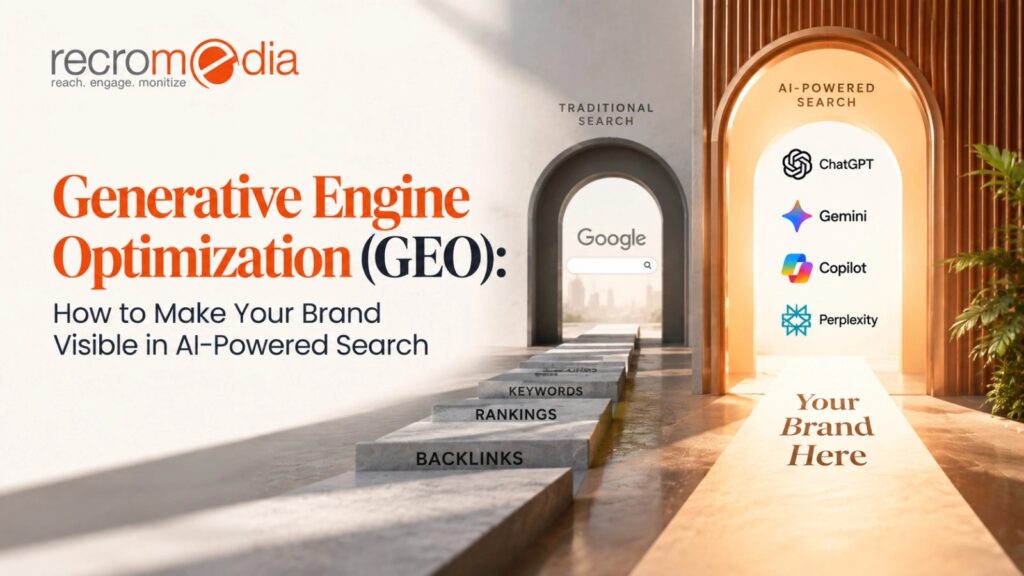
Generative Engine Optimization (GEO): How to Make Your Brand Visible in AI-Powered Search

Search is changing from a system that simply finds webpages into an experience that can synthesise information and provide users with direct answers. Google’s AI Overviews and AI Mode are examples of this shift. In May 2026, Google also published dedicated guidance on optimising for generative AI features in Search, including guidance around content quality, local information, images, video and common misconceptions about AEO and GEO. This has made Generative Engine Optimization (GEO) an increasingly discussed concept among businesses and marketers. But GEO should not be treated as a magic formula for getting a brand mentioned by AI systems. There is no guaranteed method for making a particular business appear in an AI-generated response. The more useful approach is to understand how search is evolving and make your brand’s information genuinely useful, accessible, clear and trustworthy. What Is Generative Engine Optimization? GEO is commonly used to describe efforts aimed at improving a brand’s visibility within generative or AI-powered search experiences. Unlike conventional search, where a user may receive a list of webpages, generative search experiences can synthesise information from multiple sources to construct an answer. For businesses, this changes the question from: “How do I rank for this keyword?” to a broader question: “How can my brand become a useful and credible source when people search for information related to what I offer?” That does not mean abandoning traditional SEO. In fact, Google’s current guidance explicitly states that SEO best practices continue to be relevant to its generative AI features. GEO Is Not a Replacement for SEO One of the biggest misconceptions around GEO is that businesses need an entirely separate set of technical tricks to appear in AI-powered search.Google’s current documentation does not support that idea. Instead, its guidance emphasises established fundamentals: creating useful content, ensuring pages can be crawled and indexed, providing relevant information and avoiding practices designed primarily to manipulate search systems. This means a strong Search Engine Optimization Services strategy can provide an important foundation for visibility in evolving search experiences. GEO should therefore be viewed as an extension of a broader search and content strategy, not a replacement for it. Create Information AI Systems Can Understand A brand cannot be meaningfully understood if its information is unclear or inconsistent.Businesses should make important information easy to find across their digital presence. That can include: The goal is not to write content specifically for machines.It is to make the information useful for people while presenting it in a structure that search systems can understand. Go Beyond Generic Content This is where many businesses can make a meaningful difference.If a website simply repeats information that can be found on hundreds of other pages, it gives users and search systems, little reason to consider it distinctive.Google’s current generative-AI guidance specifically highlights the importance of non-commodity content: information that provides genuine value instead of simply reproducing existing material. For a business, that could mean sharing: The objective is not more content.It is more useful content. Build a Strong Information Ecosystem One article rarely establishes a brand as an authority on an entire subject. A stronger approach is to build connected content around the areas in which the business has genuine expertise. For example, a digital marketing company could create resources covering SEO, paid advertising, content strategy, social media, conversion optimisation and changing search behaviour. These pages can be connected through relevant internal links, creating a coherent information ecosystem.This also gives the website more opportunities to answer different types of questions rather than relying on one page to do everything. Make Your Brand’s Entity Information Clear AI-powered search is not only about individual articles.A business also needs a clear digital identity. Its website should make fundamental information easy to understand: what the business does, which services it provides, where it operates and what expertise it represents. Structured data can help Google understand certain types of information on webpages. However, Google does not guarantee that implementing structured data will result in a particular search appearance.That distinction is important.Structured data can support understanding; it is not a guarantee of visibility. Don’t Ignore Images, Video and Local Information Generative search is not restricted to text.Google’s current guidance specifically discusses providing local, shopping, image and video content where relevant.For businesses, this means their digital presence should reflect the way customers actually research products and services. A restaurant, for example, may benefit from useful local information and visual content. A fashion brand may need strong product imagery and video. A service business may need detailed explanations, examples and location information.The right formats depend on the business and its audience. Avoid Chasing Artificial AI Visibility There is a temptation to create content specifically designed to manipulate AI-generated answers.That is a risky direction. Google’s spam policies apply to generative AI responses as well as conventional Search. Its policies specifically address scaled content created primarily to manipulate search rankings rather than help users.This is another reason quality matters more than volume. Publishing hundreds of shallow pages will not automatically make a brand more visible in AI-powered search. How RecroMedia Approaches GEO At RecroMedia, GEO is best approached as part of a wider search strategy. The focus should begin with understanding what the audience wants to know, how that information is being searched for and whether the brand has created genuinely useful resources around those needs.That means bringing together content strategy, website optimisation, search intent and SEO Services Agency expertise rather than treating GEO as an isolated technical exercise. The objective is not to promise that a brand will appear in every AI-generated answer.It is to build a stronger digital information footprint that gives search systems more useful, accurate and relevant information about the brand. The Real Goal of GEO The rise of AI-powered search does not make traditional SEO irrelevant.It makes useful information even more important.Businesses that want to remain discoverable should focus on building expertise, answering real questions, maintaining accurate information and creating content that provides genuine value. There is no guaranteed GEO shortcut.But there is a

Blog

Google Ads Strategy: How to Build Campaigns That Drive Quality Leads and Conversions

Getting clicks from Google Ads is relatively straightforward. Getting the right people to click, take action and eventually become customers is a different challenge altogether.A campaign can generate hundreds of clicks and still deliver very little business value if the targeting is too broad, the landing page is poorly aligned with the ad, or the campaign is optimised for the wrong conversion. That is why effective Google Ads management begins long before an advertisement appears in a search result. It starts with understanding the business objective, the customer’s search intent and what should happen after someone clicks. For businesses investing in Online Advertising Campaigns, the goal should not simply be more traffic. It should be better-qualified traffic that has a meaningful chance of converting. Start With the Conversion You Actually Want Before choosing keywords or writing ad copy, define what a valuable conversion means for the business. Depending on the business model, this could be a purchase, enquiry, qualified lead, phone call, registration or another meaningful action. Google Ads conversion tracking allows advertisers to measure actions that matter to the business and use that information to optimise campaigns. This distinction matters because a campaign optimised around clicks can behave very differently from one designed around conversions. At RecroMedia, this is an important part of approaching paid advertising strategically: the campaign objective needs to connect with the actual business objective. Build Campaigns Around Search Intent Not every search represents the same level of buying intent. Someone searching for “what is digital marketing” is at a very different stage from someone searching for “digital marketing agency in Bangalore.” A strong online advertising agency strategy therefore considers what the user is actually trying to accomplish with the search. Keywords and ad groups should be organised around closely related themes so that the search, advertisement and landing page make sense together. Google also recommends maintaining relevant campaign and ad-group structures rather than creating unnecessarily complicated account structures. The objective is simple: when someone searches, the advertisement should feel like a relevant answer to that search. Choose Keyword Match Types Intentionally Google Ads currently offers broad, phrase and exact match options for Search campaigns, each providing a different degree of control over which searches can trigger an ad. Broad match can help discover a wider range of relevant searches, particularly when combined with conversion-focused Smart Bidding. Phrase and exact match can provide additional control in situations where tighter matching is appropriate. There is no universal rule that one match type is always the right choice. The appropriate approach depends on the campaign objective, conversion data, account structure and how much control is required over search matching. Use Negative Keywords to Reduce Wasted Traffic One of the most useful parts of campaign optimisation is understanding which searches are actually triggering the ads.The Search Terms Report can reveal searches that are relevant, searches that could become new keyword opportunities and searches that have little connection to the business. Irrelevant searches can then be excluded with negative keywords. This is particularly important when the goal is quality leads rather than simply increasing the number of clicks. More traffic is not automatically better traffic. Make the Advertisement Match the Search A user who searches for a particular service should encounter an advertisement that clearly addresses that need. The messaging should accurately communicate what is being offered and lead to a relevant landing page. Google recommends creating ads that directly relate to what customers want and maintaining relevance between keywords, ads and landing pages.This alignment can make the journey from search to conversion much clearer. Don’t Ignore the Landing Page The advertisement is only one part of the conversion journey. If a person clicks on an ad promising a particular service but reaches a generic homepage with no obvious next step, the campaign can lose valuable opportunities. The landing page should therefore continue the conversation started by the advertisement.It should clearly communicate the relevant offering, provide enough information to support the decision and make the intended action easy to understand. In practical terms, the journey should feel connected: Search → Ad → Landing Page → Conversion A weakness at any stage can affect the overall campaign. Let Conversion Data Guide Bidding Google Ads offers Smart Bidding strategies that use Google AI to optimise bids for conversions or conversion value at auction time. These include strategies such as Maximize Conversions, Target CPA, Target ROAS and Maximize Conversion Value.However, automation does not remove the need for accurate measurement. If the conversion signals being provided to the system do not represent meaningful business outcomes, automated bidding has less useful information to work with.That is why tracking the right conversions is foundational to a conversion-focused campaign. Optimise From Real Search Behaviour A Google Ads campaign should not be treated as something that is built once and left untouched.Actual search behaviour provides information that can be used to refine the campaign over time. The Search Terms Report can help identify irrelevant searches, discover new opportunities and evaluate how keyword matching is working. At RecroMedia, this kind of ongoing analysis is central to building Advertising Services in Bangalore that are driven by relevance and business objectives rather than simply by campaign activity. Quality Leads Over Vanity Metrics Clicks, impressions and click-through rate can provide useful information, but they should not automatically be treated as the final measure of success. For a lead-generation business, the more important question is whether the campaign is attracting people who are genuinely interested in the offering. That means looking beyond surface-level activity and evaluating conversions, lead quality, landing-page performance and the relationship between advertising spend and meaningful outcomes. A Better Way to Approach Google Ads A successful Google Ads strategy is not built around one clever keyword or one compelling advertisement. It is the result of several connected decisions: For businesses considering Digital Marketing Services in Bangalore, paid advertising works best when it is treated as part of a broader digital strategy rather than an isolated source of clicks. That

SEO Services In Bangalore
Blog

SEO Strategy for Businesses: How to Build Sustainable Organic Growth in 2026

Organic growth is rarely the result of one perfectly optimised page. A business can publish regularly, target keywords and make technical improvements, yet still struggle to build meaningful visibility if those activities are not connected to what people actually search for and need. In 2026, SEO Services In Bangalore and broader search optimisation involve more than trying to rank a page for a particular phrase. Search has expanded across traditional results, AI-powered experiences, images, video and other formats. Google itself now provides guidance on optimising for generative AI features while emphasising that established SEO fundamentals continue to matter. For businesses, the better question is no longer simply, “How do we rank?” It is: “How do we become genuinely useful and discoverable when our potential customers search?” Start With Search Intent, Not Just Keywords Keywords remain useful, but a list of keywords is not an SEO strategy. A business first needs to understand what someone is trying to accomplish with a search. A person searching for a broad informational query may be researching a problem. Someone searching for a specific service may already be evaluating providers. Another user may be looking for a nearby business or trying to compare available options. These different intentions require different types of content. That means an effective SEO strategy should map important searches to the pages, information and experiences that can genuinely satisfy them. For businesses working with a Best SEO Provider, this intent-first approach can help ensure that optimisation decisions are connected to actual customer needs rather than keyword volume alone. Build Content That Deserves to Be Found Google’s guidance consistently emphasises creating helpful, reliable, people-first content rather than content produced primarily to manipulate rankings. Its spam policies also specifically warn against scaled content created mainly to influence search rankings without providing meaningful value. For businesses, this has a practical implication: publishing more does not automatically mean growing more. A stronger content strategy asks: The goal is to build a library of useful resources rather than a collection of pages created simply because a keyword exists. Strengthen the Website’s Technical Foundation Good content still needs a technically accessible website. SEO work can involve ensuring that important pages can be crawled and indexed, maintaining sensible site architecture, improving page experience, managing internal links and addressing technical problems that can interfere with search visibility. Structured data can also help Google understand specific types of content and, where supported, make pages eligible for certain search features. Technical SEO should therefore support the content strategy rather than exist separately from it. For businesses looking for an SEO Services Agency, this means evaluating not only content creation but also the technical systems that help search engines discover, understand and interpret the website. Think Beyond Traditional Search Results Search behaviour in 2026 is increasingly diverse. Google’s current documentation includes AI Overviews and AI Mode among its search experiences, and its guidance on generative AI features explains that traditional SEO best practices remain relevant. It also discusses the importance of useful, non-commodity content as search evolves. This is where concepts such as AEO and GEO have entered the SEO conversation, but businesses should be careful about treating them as shortcuts. There is no reliable formula that guarantees a brand will appear in an AI-generated answer. Instead, the practical approach is to make the business’s information clear, useful, trustworthy and accessible across relevant formats and platforms. For brands adapting to this shift, an AI SEO agency can approach optimisation with these changing search experiences in mind, while still building on established SEO fundamentals. In other words, optimise for being a valuable source, not merely for appearing in a particular feature. Build Topical Depth Instead of Isolated Pages A business becomes more useful to its audience when it can answer multiple connected questions around an area of expertise. For example, a company offering SEO services might create useful resources around keyword research, technical SEO, content strategy, local search, measurement and common optimisation problems. These topics can be connected through internal linking and a logical website structure. This creates a stronger information ecosystem than publishing unrelated articles simply because they have search volume. Off-page activity can complement this foundation. Working with an Off page services provider may involve building relevant references and relationships that support the website’s broader authority, rather than treating link acquisition as an isolated numbers exercise. Make Local SEO Part of the Strategy When It Matters For businesses serving specific locations, local search deserves specific attention. Accurate business information, relevant location pages and useful local content can help search engines and customers understand where and how a business operates. For a business targeting Bangalore, local relevance should be meaningful rather than simply adding “Bangalore” to every page. The content should demonstrate genuine relevance to the businesses and customers being served in that market. A Backlinks Services provider company can also form part of an off-page strategy when businesses are working to strengthen their broader online presence through relevant external references. Measure More Than Rankings Rankings are useful, but they are not the entire picture. A sustainable SEO strategy should consider metrics such as organic clicks, impressions, relevant search visibility, engagement and, where measurable, conversions or other meaningful business actions. Google Search Console provides data that can help website owners understand how their pages perform in Search. The important point is to connect SEO measurement with business objectives. A page that attracts highly relevant visitors can be more valuable than one that generates large amounts of traffic with little commercial relevance. As search increasingly includes AI-generated experiences, an AI search visibility agency may also consider how clearly a business’s information can be understood and surfaced across emerging search environments. SEO Is a Long-Term System Sustainable organic growth does not come from finding one tactic and repeating it forever. Search changes. Customer behaviour changes. Businesses change. Competitors publish new information. Websites expand and evolve. A strong SEO strategy therefore requires ongoing research, content development, technical maintenance, measurement and refinement. At RecroMedia, this

360° Digital Marketing Strategy Recro
Blog

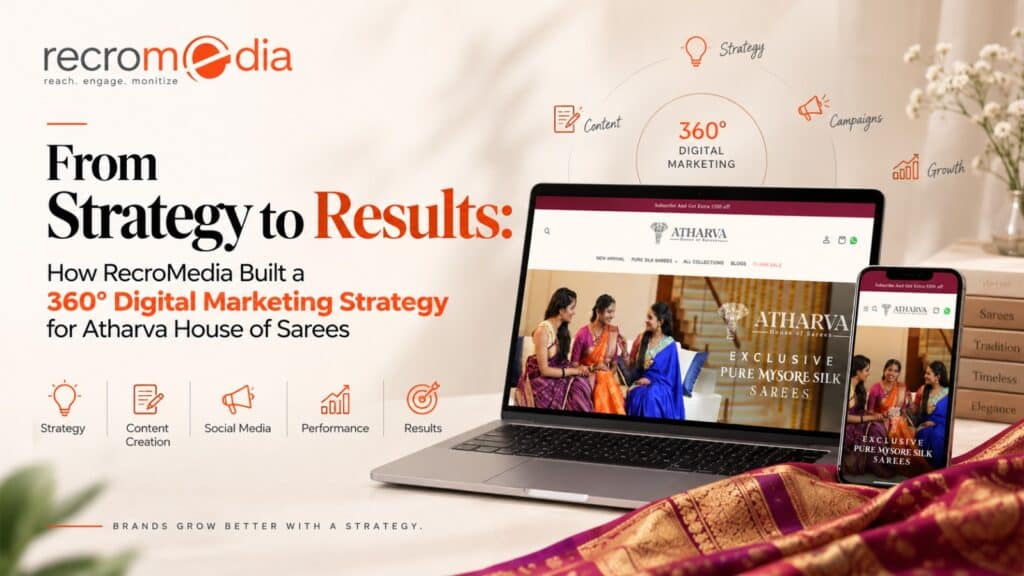
From Strategy to Results: How RecroMedia Built a 360° Digital Marketing Strategy for Atharva House of Sarees

A saree may be timeless, but the way customers discover, explore and shop for one has changed dramatically. Today, a saree brand needs more than beautiful products to stand out. It needs a digital presence that captures attention, communicates craftsmanship, creates desire and makes it easy for customers to take the next step. That is where a well-connected digital strategy makes the difference. For Atharva House of Sarees, RecroMedia developed a 360° digital marketing approach that brings together content, website optimisation, influencer collaborations, paid advertising, festive campaigns, creative production and emerging search strategies. Instead of treating each activity as a separate marketing task, the approach connects them into one consistent digital presence. Understanding the Digital Opportunity for Atharva For a saree brand, visual appeal is only one part of the equation. Customers may discover a saree through a social media reel, visit the website to explore the collection, encounter the brand again through an advertisement and eventually make a purchase after seeing a festive campaign or influencer recommendation. Every one of these touchpoints contributes to the customer’s perception of the brand. RecroMedia’s approach for Atharva was therefore built around creating consistency across these touchpoints while keeping the brand’s products and identity at the centre. Building a Content Strategy Around the Brand A strong digital presence starts with knowing what to communicate and when to communicate it. RecroMedia manages Atharva’s content calendar, creating a structured approach to the brand’s social media communication. Rather than posting simply to maintain activity, the content is planned around products, occasions, collections, brand storytelling and moments that are relevant to saree buyers. This creates a more cohesive content journey, where individual posts contribute to a larger brand narrative. For a visually driven category such as sarees, this consistency is particularly important. The content needs to showcase the product while also communicating its colours, details, styling possibilities and occasion-led appeal. Turning the Website Into a Stronger Digital Touchpoint Social media may attract attention, but the website plays an important role once a customer wants to know more. RecroMedia handles website creation and optimisation for Atharva, with a focus on making the digital experience more useful, discoverable and aligned with the brand. This includes applying the principles expected from an effective SEO Services Agency so that the website’s information and structure can better support discovery. From the way products and information are presented to the overall structure of the website, optimisation helps bridge the gap between attracting an audience and giving that audience a clear path to explore the brand. This is also where SEO and newer search approaches become increasingly relevant. Preparing for the Next Era of Search Search is no longer limited to traditional search-engine results. RecroMedia also works on AEO and GEO optimisation for Atharva, helping prepare the brand’s digital presence for the changing ways people discover information online. This work forms part of a broader AEO & GEO Services approach, where the objective is to strengthen how clearly a brand’s information is presented across evolving search experiences. The objective is not simply to chase rankings. It is to build a stronger digital information footprint so that the brand can remain discoverable as search behaviour evolves. Combining Organic Content With Paid Advertising Organic visibility and paid reach serve different purposes, and using them together can create a stronger marketing ecosystem. RecroMedia manages paid advertising for Atharva, using campaigns to put relevant products and offers in front of targeted audiences. This includes strategically planned Online Advertising Campaigns around products, launches, festive periods and special promotions. The role of paid campaigns becomes particularly important around product launches, festive periods and special promotions, when timing can significantly influence customer attention. Rather than viewing advertising as an isolated activity, it works alongside the content and creative already being developed for the brand. Making Festivals Part of the Digital Strategy For a saree brand, festivals and celebrations naturally create opportunities for meaningful communication. RecroMedia develops festive and special campaigns for Atharva, translating seasonal occasions into digital campaigns that bring together creative concepts, product communication, advertising and social content. The focus is not simply on announcing an offer. A successful festive campaign needs a reason for the audience to stop, look and engage. That requires the creative idea, visual execution, messaging and promotion to work together. Bringing Influencers Into the Brand Story Influencer marketing adds another layer to the digital journey. RecroMedia handles influencer marketing for Atharva, helping introduce the brand and its sarees through creators whose content can provide a more relatable product experience. For fashion and sarees in particular, seeing a product styled and worn can communicate something that a conventional product image cannot. Influencer content therefore becomes another bridge between product discovery and consideration. Where Creative Execution Meets Strategy Behind every campaign is a considerable amount of creative work. RecroMedia manages graphic designing and video editing for Atharva, ensuring that the brand’s visual communication remains cohesive across its digital channels. From static creatives to short-form video, the execution needs to capture attention quickly while retaining the visual character of the brand. This is especially important in social media environments where audiences scroll quickly and first impressions are made within seconds. One Strategy, Multiple Digital Touchpoints What makes Atharva’s digital marketing approach a 360° strategy is not simply the number of services involved. It is the way those services work together. Content creates ongoing communication. The website provides a destination for discovery. Influencers introduce the brand through creators. Paid advertising expands targeted reach. Festive campaigns create timely moments of attention. Graphics and video bring the ideas to life. AEO and GEO strengthen discoverability for evolving search behaviour. Each element has its own role, but together they create a more connected digital ecosystem. The RecroMedia Approach At RecroMedia, digital marketing is not viewed as a checklist of services. The stronger approach is to understand how different digital touchpoints influence the customer journey and then build a strategy where those touchpoints support one another. The work with Atharva House of

Scroll to Top