Blog

Answer Engine Optimization - Recro
Blog

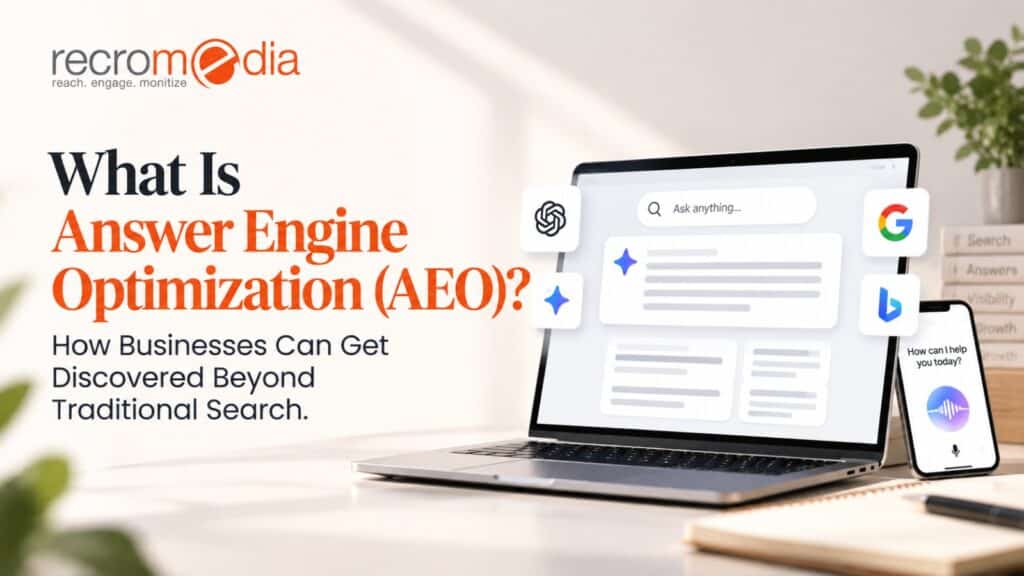
What Is Answer Engine Optimization (AEO)? How Businesses Can Get Discovered Beyond Traditional Search

Search is no longer limited to a list of blue links. People increasingly expect search engines to understand complete questions, compare information and provide direct answers. Google’s search experience now includes AI Overviews and AI Mode, alongside traditional results and other search formats. Google has also published specific guidance for websites seeking visibility in generative AI features. This shift has brought Answer Engine Optimization (AEO) into the digital marketing conversation. But AEO is often misunderstood. It is not a secret formula for making a business appear in every AI-generated answer. Instead, it is better understood as an approach to structuring and creating useful information so that answer-oriented search experiences can understand, interpret and potentially surface it. For businesses, that means thinking beyond simply ranking for keywords. What Is Answer Engine Optimization? So, what is AEO in digital marketing? Broadly, Answer Engine Optimization refers to the practice of creating and structuring content so it can effectively answer the questions people ask through search and answer-oriented systems. Traditional SEO often focuses on helping pages become discoverable and relevant for searches. AEO places additional emphasis on clear questions, direct answers, context and information that genuinely satisfies a user’s intent. The two approaches are not competitors. In fact, Google’s current guidance for generative AI features explicitly states that traditional SEO fundamentals remain relevant. Google also says there are no additional technical requirements or special schema specifically required for appearing in AI Overviews or AI Mode. Why Does AEO Matter for Businesses? Imagine someone searching: “What should a small business look for when choosing a digital marketing agency?” A page that simply repeats the phrase “digital marketing agency” dozens of times is unlikely to provide much value. A useful resource could explain what businesses should evaluate, how to compare services, which questions to ask an agency and what warning signs to consider. That difference matters because modern search is increasingly concerned with understanding information and connecting users with useful sources. Google’s 2026 guidance on generative AI specifically highlights the importance of non-commodity content, information that offers genuine value rather than simply reproducing what is already available elsewhere. For businesses exploring AEO services, the focus should therefore be on creating information that genuinely helps users rather than trying to manipulate how answer systems respond. AEO Starts With Understanding Questions One of the most practical ways to approach AEO is to understand the questions your audience actually asks. These might include: These questions can inform articles, service pages, FAQs, guides and other useful resources. The objective is not to create a separate page for every imaginable question. It is to build authoritative resources that answer related questions comprehensively. Make Answers Clear and Specific Answer-oriented content benefits from clarity. If a page discusses a question, the answer should not be buried beneath several paragraphs of generic introduction. A useful structure might be: Question → Direct answer → Explanation → Supporting details → Practical example This makes information easier for readers to navigate and gives search systems clearer contextual signals. However, clarity should not become oversimplification. Complex subjects still require nuance, qualifications and supporting explanation. An AEO agency can help businesses structure this information around real user questions while keeping the content useful and natural for human readers. Build Genuine Topical Authority A business should not rely on one article to establish expertise. Suppose a company provides SEO services. Its website could develop useful resources covering technical SEO, search intent, content strategy, local search, website optimisation, measurement and common SEO problems. These resources can be connected through sensible internal linking and a logical website structure. Over time, this creates a deeper information environment around the company’s expertise. That is considerably more useful than producing dozens of thin articles simply because individual keywords have search volume. This broader approach is also where Answer Engine Optimization services can complement content and website optimisation efforts, helping businesses organise their knowledge around the topics and questions that matter to their audiences. Don’t Treat AEO as a Replacement for SEO This is one of the most important distinctions businesses should understand. Google’s current guidance does not describe AEO as a separate technical system that replaces SEO. Its documentation says the same SEO best practices remain relevant to generative AI features in Search. That means businesses should continue paying attention to fundamentals such as: Structured data can help Google understand certain types of content and may make eligible pages suitable for specific search features, although structured data does not guarantee that a particular feature will appear. What About GEO? You may also come across the term Generative Engine Optimization (GEO). The terminology is still evolving, and it is important not to treat every new acronym as a completely new discipline. Google’s own 2026 documentation addresses AEO/GEO misconceptions and focuses instead on established principles: create valuable content, make information accessible, provide relevant content in formats such as text, images and video where appropriate, and maintain strong SEO fundamentals. In practice, businesses should focus less on chasing terminology and more on becoming a useful, credible source of information. How RecroMedia Approaches AEO At RecroMedia, AEO fits into a broader search strategy rather than being treated as an isolated optimisation trick. The starting point is understanding what audiences want to know, how they search for that information and whether the business’s digital presence provides a clear and useful answer. That means combining content strategy, search intent, website optimisation and SEO with an understanding of how search experiences are evolving. For businesses adapting to AI-powered discovery, working with an Answer Engine Optimization agency can involve developing content and information structures that are clearer for both users and evolving search experiences. There is no legitimate shortcut that guarantees inclusion in an AI-generated answer. What businesses can control is the quality of the information they publish, how clearly that information is presented and how effectively their website communicates their expertise. The Future of Search Is About Being Useful AEO does not mean abandoning traditional search. It means recognising that discovery
Blog

Google Ads Strategy: How to Build Campaigns That Drive Quality Leads and Conversions

Getting clicks from Google Ads is relatively straightforward. Getting the right people to click, take action and eventually become customers is a different challenge altogether.A campaign can generate hundreds of clicks and still deliver very little business value if the targeting is too broad, the landing page is poorly aligned with the ad, or the campaign is optimised for the wrong conversion. That is why effective Google Ads management begins long before an advertisement appears in a search result. It starts with understanding the business objective, the customer’s search intent and what should happen after someone clicks. For businesses investing in Online Advertising Campaigns, the goal should not simply be more traffic. It should be better-qualified traffic that has a meaningful chance of converting. Start With the Conversion You Actually Want Before choosing keywords or writing ad copy, define what a valuable conversion means for the business. Depending on the business model, this could be a purchase, enquiry, qualified lead, phone call, registration or another meaningful action. Google Ads conversion tracking allows advertisers to measure actions that matter to the business and use that information to optimise campaigns. This distinction matters because a campaign optimised around clicks can behave very differently from one designed around conversions. At RecroMedia, this is an important part of approaching paid advertising strategically: the campaign objective needs to connect with the actual business objective. Build Campaigns Around Search Intent Not every search represents the same level of buying intent. Someone searching for “what is digital marketing” is at a very different stage from someone searching for “digital marketing agency in Bangalore.” A strong online advertising agency strategy therefore considers what the user is actually trying to accomplish with the search. Keywords and ad groups should be organised around closely related themes so that the search, advertisement and landing page make sense together. Google also recommends maintaining relevant campaign and ad-group structures rather than creating unnecessarily complicated account structures. The objective is simple: when someone searches, the advertisement should feel like a relevant answer to that search. Choose Keyword Match Types Intentionally Google Ads currently offers broad, phrase and exact match options for Search campaigns, each providing a different degree of control over which searches can trigger an ad. Broad match can help discover a wider range of relevant searches, particularly when combined with conversion-focused Smart Bidding. Phrase and exact match can provide additional control in situations where tighter matching is appropriate. There is no universal rule that one match type is always the right choice. The appropriate approach depends on the campaign objective, conversion data, account structure and how much control is required over search matching. Use Negative Keywords to Reduce Wasted Traffic One of the most useful parts of campaign optimisation is understanding which searches are actually triggering the ads.The Search Terms Report can reveal searches that are relevant, searches that could become new keyword opportunities and searches that have little connection to the business. Irrelevant searches can then be excluded with negative keywords. This is particularly important when the goal is quality leads rather than simply increasing the number of clicks. More traffic is not automatically better traffic. Make the Advertisement Match the Search A user who searches for a particular service should encounter an advertisement that clearly addresses that need. The messaging should accurately communicate what is being offered and lead to a relevant landing page. Google recommends creating ads that directly relate to what customers want and maintaining relevance between keywords, ads and landing pages.This alignment can make the journey from search to conversion much clearer. Don’t Ignore the Landing Page The advertisement is only one part of the conversion journey. If a person clicks on an ad promising a particular service but reaches a generic homepage with no obvious next step, the campaign can lose valuable opportunities. The landing page should therefore continue the conversation started by the advertisement.It should clearly communicate the relevant offering, provide enough information to support the decision and make the intended action easy to understand. In practical terms, the journey should feel connected: Search → Ad → Landing Page → Conversion A weakness at any stage can affect the overall campaign. Let Conversion Data Guide Bidding Google Ads offers Smart Bidding strategies that use Google AI to optimise bids for conversions or conversion value at auction time. These include strategies such as Maximize Conversions, Target CPA, Target ROAS and Maximize Conversion Value.However, automation does not remove the need for accurate measurement. If the conversion signals being provided to the system do not represent meaningful business outcomes, automated bidding has less useful information to work with.That is why tracking the right conversions is foundational to a conversion-focused campaign. Optimise From Real Search Behaviour A Google Ads campaign should not be treated as something that is built once and left untouched.Actual search behaviour provides information that can be used to refine the campaign over time. The Search Terms Report can help identify irrelevant searches, discover new opportunities and evaluate how keyword matching is working. At RecroMedia, this kind of ongoing analysis is central to building Advertising Services in Bangalore that are driven by relevance and business objectives rather than simply by campaign activity. Quality Leads Over Vanity Metrics Clicks, impressions and click-through rate can provide useful information, but they should not automatically be treated as the final measure of success. For a lead-generation business, the more important question is whether the campaign is attracting people who are genuinely interested in the offering. That means looking beyond surface-level activity and evaluating conversions, lead quality, landing-page performance and the relationship between advertising spend and meaningful outcomes. A Better Way to Approach Google Ads A successful Google Ads strategy is not built around one clever keyword or one compelling advertisement. It is the result of several connected decisions: For businesses considering Digital Marketing Services in Bangalore, paid advertising works best when it is treated as part of a broader digital strategy rather than an isolated source of clicks. That

Generative Engine Optimization
Blog

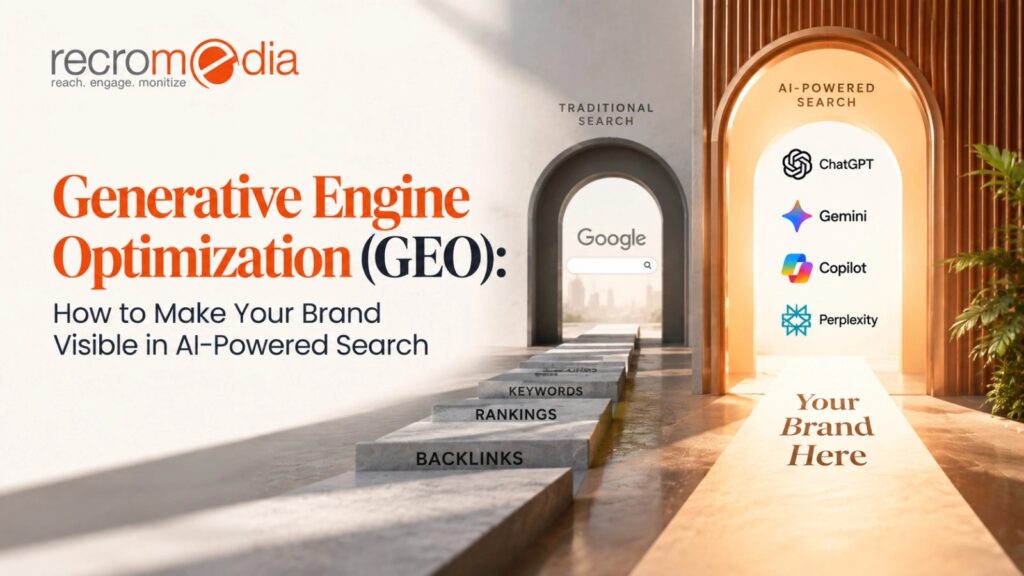
Generative Engine Optimization (GEO): How to Make Your Brand Visible in AI-Powered Search

Search is changing from a system that simply finds webpages into an experience that can synthesise information and provide users with direct answers. Google’s AI Overviews and AI Mode are examples of this shift. In May 2026, Google also published dedicated guidance on optimising for generative AI features in Search, including guidance around content quality, local information, images, video and common misconceptions about AEO and GEO. This has made Generative Engine Optimization (GEO) an increasingly discussed concept among businesses and marketers. But GEO should not be treated as a magic formula for getting a brand mentioned by AI systems. There is no guaranteed method for making a particular business appear in an AI-generated response. The more useful approach is to understand how search is evolving and make your brand’s information genuinely useful, accessible, clear and trustworthy. What Is Generative Engine Optimization? GEO is commonly used to describe efforts aimed at improving a brand’s visibility within generative or AI-powered search experiences. Unlike conventional search, where a user may receive a list of webpages, generative search experiences can synthesise information from multiple sources to construct an answer. For businesses, this changes the question from: “How do I rank for this keyword?” to a broader question: “How can my brand become a useful and credible source when people search for information related to what I offer?” That does not mean abandoning traditional SEO. In fact, Google’s current guidance explicitly states that SEO best practices continue to be relevant to its generative AI features. GEO Is Not a Replacement for SEO One of the biggest misconceptions around GEO is that businesses need an entirely separate set of technical tricks to appear in AI-powered search.Google’s current documentation does not support that idea. Instead, its guidance emphasises established fundamentals: creating useful content, ensuring pages can be crawled and indexed, providing relevant information and avoiding practices designed primarily to manipulate search systems. This means a strong Search Engine Optimization Services strategy can provide an important foundation for visibility in evolving search experiences. GEO should therefore be viewed as an extension of a broader search and content strategy, not a replacement for it. Create Information AI Systems Can Understand A brand cannot be meaningfully understood if its information is unclear or inconsistent.Businesses should make important information easy to find across their digital presence. That can include: The goal is not to write content specifically for machines.It is to make the information useful for people while presenting it in a structure that search systems can understand. Go Beyond Generic Content This is where many businesses can make a meaningful difference.If a website simply repeats information that can be found on hundreds of other pages, it gives users and search systems, little reason to consider it distinctive.Google’s current generative-AI guidance specifically highlights the importance of non-commodity content: information that provides genuine value instead of simply reproducing existing material. For a business, that could mean sharing: The objective is not more content.It is more useful content. Build a Strong Information Ecosystem One article rarely establishes a brand as an authority on an entire subject. A stronger approach is to build connected content around the areas in which the business has genuine expertise. For example, a digital marketing company could create resources covering SEO, paid advertising, content strategy, social media, conversion optimisation and changing search behaviour. These pages can be connected through relevant internal links, creating a coherent information ecosystem.This also gives the website more opportunities to answer different types of questions rather than relying on one page to do everything. Make Your Brand’s Entity Information Clear AI-powered search is not only about individual articles.A business also needs a clear digital identity. Its website should make fundamental information easy to understand: what the business does, which services it provides, where it operates and what expertise it represents. Structured data can help Google understand certain types of information on webpages. However, Google does not guarantee that implementing structured data will result in a particular search appearance.That distinction is important.Structured data can support understanding; it is not a guarantee of visibility. Don’t Ignore Images, Video and Local Information Generative search is not restricted to text.Google’s current guidance specifically discusses providing local, shopping, image and video content where relevant.For businesses, this means their digital presence should reflect the way customers actually research products and services. A restaurant, for example, may benefit from useful local information and visual content. A fashion brand may need strong product imagery and video. A service business may need detailed explanations, examples and location information.The right formats depend on the business and its audience. Avoid Chasing Artificial AI Visibility There is a temptation to create content specifically designed to manipulate AI-generated answers.That is a risky direction. Google’s spam policies apply to generative AI responses as well as conventional Search. Its policies specifically address scaled content created primarily to manipulate search rankings rather than help users.This is another reason quality matters more than volume. Publishing hundreds of shallow pages will not automatically make a brand more visible in AI-powered search. How RecroMedia Approaches GEO At RecroMedia, GEO is best approached as part of a wider search strategy. The focus should begin with understanding what the audience wants to know, how that information is being searched for and whether the brand has created genuinely useful resources around those needs.That means bringing together content strategy, website optimisation, search intent and SEO Services Agency expertise rather than treating GEO as an isolated technical exercise. The objective is not to promise that a brand will appear in every AI-generated answer.It is to build a stronger digital information footprint that gives search systems more useful, accurate and relevant information about the brand. The Real Goal of GEO The rise of AI-powered search does not make traditional SEO irrelevant.It makes useful information even more important.Businesses that want to remain discoverable should focus on building expertise, answering real questions, maintaining accurate information and creating content that provides genuine value. There is no guaranteed GEO shortcut.But there is a

SEO Services In Bangalore
Blog

SEO Strategy for Businesses: How to Build Sustainable Organic Growth in 2026

Organic growth is rarely the result of one perfectly optimised page. A business can publish regularly, target keywords and make technical improvements, yet still struggle to build meaningful visibility if those activities are not connected to what people actually search for and need. In 2026, SEO Services In Bangalore and broader search optimisation involve more than trying to rank a page for a particular phrase. Search has expanded across traditional results, AI-powered experiences, images, video and other formats. Google itself now provides guidance on optimising for generative AI features while emphasising that established SEO fundamentals continue to matter. For businesses, the better question is no longer simply, “How do we rank?” It is: “How do we become genuinely useful and discoverable when our potential customers search?” Start With Search Intent, Not Just Keywords Keywords remain useful, but a list of keywords is not an SEO strategy. A business first needs to understand what someone is trying to accomplish with a search. A person searching for a broad informational query may be researching a problem. Someone searching for a specific service may already be evaluating providers. Another user may be looking for a nearby business or trying to compare available options. These different intentions require different types of content. That means an effective SEO strategy should map important searches to the pages, information and experiences that can genuinely satisfy them. For businesses working with a Best SEO Provider, this intent-first approach can help ensure that optimisation decisions are connected to actual customer needs rather than keyword volume alone. Build Content That Deserves to Be Found Google’s guidance consistently emphasises creating helpful, reliable, people-first content rather than content produced primarily to manipulate rankings. Its spam policies also specifically warn against scaled content created mainly to influence search rankings without providing meaningful value. For businesses, this has a practical implication: publishing more does not automatically mean growing more. A stronger content strategy asks: The goal is to build a library of useful resources rather than a collection of pages created simply because a keyword exists. Strengthen the Website’s Technical Foundation Good content still needs a technically accessible website. SEO work can involve ensuring that important pages can be crawled and indexed, maintaining sensible site architecture, improving page experience, managing internal links and addressing technical problems that can interfere with search visibility. Structured data can also help Google understand specific types of content and, where supported, make pages eligible for certain search features. Technical SEO should therefore support the content strategy rather than exist separately from it. For businesses looking for an SEO Services Agency, this means evaluating not only content creation but also the technical systems that help search engines discover, understand and interpret the website. Think Beyond Traditional Search Results Search behaviour in 2026 is increasingly diverse. Google’s current documentation includes AI Overviews and AI Mode among its search experiences, and its guidance on generative AI features explains that traditional SEO best practices remain relevant. It also discusses the importance of useful, non-commodity content as search evolves. This is where concepts such as AEO and GEO have entered the SEO conversation, but businesses should be careful about treating them as shortcuts. There is no reliable formula that guarantees a brand will appear in an AI-generated answer. Instead, the practical approach is to make the business’s information clear, useful, trustworthy and accessible across relevant formats and platforms. For brands adapting to this shift, an AI SEO agency can approach optimisation with these changing search experiences in mind, while still building on established SEO fundamentals. In other words, optimise for being a valuable source, not merely for appearing in a particular feature. Build Topical Depth Instead of Isolated Pages A business becomes more useful to its audience when it can answer multiple connected questions around an area of expertise. For example, a company offering SEO services might create useful resources around keyword research, technical SEO, content strategy, local search, measurement and common optimisation problems. These topics can be connected through internal linking and a logical website structure. This creates a stronger information ecosystem than publishing unrelated articles simply because they have search volume. Off-page activity can complement this foundation. Working with an Off page services provider may involve building relevant references and relationships that support the website’s broader authority, rather than treating link acquisition as an isolated numbers exercise. Make Local SEO Part of the Strategy When It Matters For businesses serving specific locations, local search deserves specific attention. Accurate business information, relevant location pages and useful local content can help search engines and customers understand where and how a business operates. For a business targeting Bangalore, local relevance should be meaningful rather than simply adding “Bangalore” to every page. The content should demonstrate genuine relevance to the businesses and customers being served in that market. A Backlinks Services provider company can also form part of an off-page strategy when businesses are working to strengthen their broader online presence through relevant external references. Measure More Than Rankings Rankings are useful, but they are not the entire picture. A sustainable SEO strategy should consider metrics such as organic clicks, impressions, relevant search visibility, engagement and, where measurable, conversions or other meaningful business actions. Google Search Console provides data that can help website owners understand how their pages perform in Search. The important point is to connect SEO measurement with business objectives. A page that attracts highly relevant visitors can be more valuable than one that generates large amounts of traffic with little commercial relevance. As search increasingly includes AI-generated experiences, an AI search visibility agency may also consider how clearly a business’s information can be understood and surfaced across emerging search environments. SEO Is a Long-Term System Sustainable organic growth does not come from finding one tactic and repeating it forever. Search changes. Customer behaviour changes. Businesses change. Competitors publish new information. Websites expand and evolve. A strong SEO strategy therefore requires ongoing research, content development, technical maintenance, measurement and refinement. At RecroMedia, this

360° Digital Marketing Strategy Recro
Blog

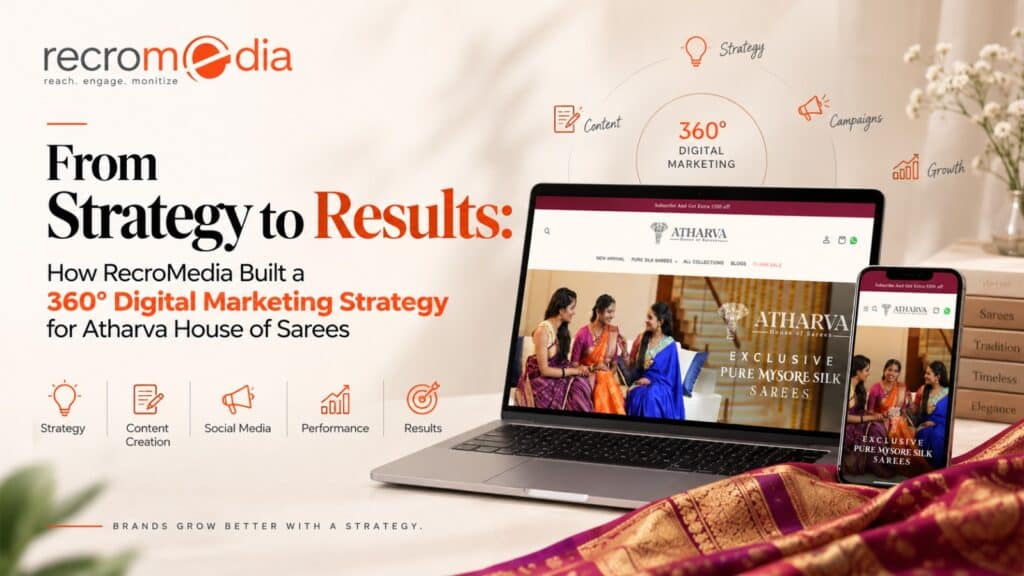
From Strategy to Results: How RecroMedia Built a 360° Digital Marketing Strategy for Atharva House of Sarees

A saree may be timeless, but the way customers discover, explore and shop for one has changed dramatically. Today, a saree brand needs more than beautiful products to stand out. It needs a digital presence that captures attention, communicates craftsmanship, creates desire and makes it easy for customers to take the next step. That is where a well-connected digital strategy makes the difference. For Atharva House of Sarees, RecroMedia developed a 360° digital marketing approach that brings together content, website optimisation, influencer collaborations, paid advertising, festive campaigns, creative production and emerging search strategies. Instead of treating each activity as a separate marketing task, the approach connects them into one consistent digital presence. Understanding the Digital Opportunity for Atharva For a saree brand, visual appeal is only one part of the equation. Customers may discover a saree through a social media reel, visit the website to explore the collection, encounter the brand again through an advertisement and eventually make a purchase after seeing a festive campaign or influencer recommendation. Every one of these touchpoints contributes to the customer’s perception of the brand. RecroMedia’s approach for Atharva was therefore built around creating consistency across these touchpoints while keeping the brand’s products and identity at the centre. Building a Content Strategy Around the Brand A strong digital presence starts with knowing what to communicate and when to communicate it. RecroMedia manages Atharva’s content calendar, creating a structured approach to the brand’s social media communication. Rather than posting simply to maintain activity, the content is planned around products, occasions, collections, brand storytelling and moments that are relevant to saree buyers. This creates a more cohesive content journey, where individual posts contribute to a larger brand narrative. For a visually driven category such as sarees, this consistency is particularly important. The content needs to showcase the product while also communicating its colours, details, styling possibilities and occasion-led appeal. Turning the Website Into a Stronger Digital Touchpoint Social media may attract attention, but the website plays an important role once a customer wants to know more. RecroMedia handles website creation and optimisation for Atharva, with a focus on making the digital experience more useful, discoverable and aligned with the brand. This includes applying the principles expected from an effective SEO Services Agency so that the website’s information and structure can better support discovery. From the way products and information are presented to the overall structure of the website, optimisation helps bridge the gap between attracting an audience and giving that audience a clear path to explore the brand. This is also where SEO and newer search approaches become increasingly relevant. Preparing for the Next Era of Search Search is no longer limited to traditional search-engine results. RecroMedia also works on AEO and GEO optimisation for Atharva, helping prepare the brand’s digital presence for the changing ways people discover information online. This work forms part of a broader AEO & GEO Services approach, where the objective is to strengthen how clearly a brand’s information is presented across evolving search experiences. The objective is not simply to chase rankings. It is to build a stronger digital information footprint so that the brand can remain discoverable as search behaviour evolves. Combining Organic Content With Paid Advertising Organic visibility and paid reach serve different purposes, and using them together can create a stronger marketing ecosystem. RecroMedia manages paid advertising for Atharva, using campaigns to put relevant products and offers in front of targeted audiences. This includes strategically planned Online Advertising Campaigns around products, launches, festive periods and special promotions. The role of paid campaigns becomes particularly important around product launches, festive periods and special promotions, when timing can significantly influence customer attention. Rather than viewing advertising as an isolated activity, it works alongside the content and creative already being developed for the brand. Making Festivals Part of the Digital Strategy For a saree brand, festivals and celebrations naturally create opportunities for meaningful communication. RecroMedia develops festive and special campaigns for Atharva, translating seasonal occasions into digital campaigns that bring together creative concepts, product communication, advertising and social content. The focus is not simply on announcing an offer. A successful festive campaign needs a reason for the audience to stop, look and engage. That requires the creative idea, visual execution, messaging and promotion to work together. Bringing Influencers Into the Brand Story Influencer marketing adds another layer to the digital journey. RecroMedia handles influencer marketing for Atharva, helping introduce the brand and its sarees through creators whose content can provide a more relatable product experience. For fashion and sarees in particular, seeing a product styled and worn can communicate something that a conventional product image cannot. Influencer content therefore becomes another bridge between product discovery and consideration. Where Creative Execution Meets Strategy Behind every campaign is a considerable amount of creative work. RecroMedia manages graphic designing and video editing for Atharva, ensuring that the brand’s visual communication remains cohesive across its digital channels. From static creatives to short-form video, the execution needs to capture attention quickly while retaining the visual character of the brand. This is especially important in social media environments where audiences scroll quickly and first impressions are made within seconds. One Strategy, Multiple Digital Touchpoints What makes Atharva’s digital marketing approach a 360° strategy is not simply the number of services involved. It is the way those services work together. Content creates ongoing communication. The website provides a destination for discovery. Influencers introduce the brand through creators. Paid advertising expands targeted reach. Festive campaigns create timely moments of attention. Graphics and video bring the ideas to life. AEO and GEO strengthen discoverability for evolving search behaviour. Each element has its own role, but together they create a more connected digital ecosystem. The RecroMedia Approach At RecroMedia, digital marketing is not viewed as a checklist of services. The stronger approach is to understand how different digital touchpoints influence the customer journey and then build a strategy where those touchpoints support one another. The work with Atharva House of

Blog

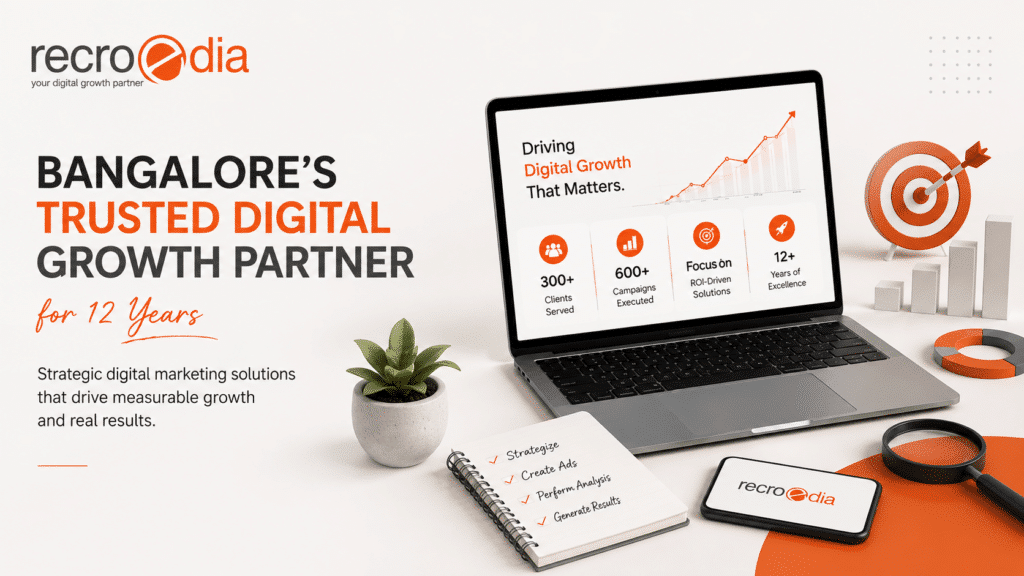
About Recro Media: Bangalore’s Trusted Digital Growth Partner for 12 Years

For over a decade, Recro Media has helped brands move from being invisible online to being unavoidable. We are a full-service Digital Marketing Agency in Bangalore built on one simple belief: growth should be measurable, not guesswork. What started as a small team with big ideas has grown into a results-driven partner for FMCG brands, real estate developers, fintech companies, and D2C startups across India. Our approach blends strategy, creativity, and data so that every campaign we run answers a business question, not just a vanity metric. This is the foundation Recro Media was built on, and it’s the foundation we still operate from today. How Recro Media Helps Clients Win Online Every client comes to us with a different problem; some need visibility, some need leads, some need to defend market share against louder competitors. Our process starts with a deep audit of the client’s digital footprint, their competitors, and their audience behaviour. From there, we build a custom roadmap instead of a template. As one of the most consistent providers of Digital Marketing Services in Bangalore, we don’t just execute campaigns; we embed ourselves in the client’s growth goals, tracking performance weekly and adjusting strategy in real time. This is why brands like Mount Roof, Muthoot Fincorp, Rapido, Zepto, and ITC have trusted us to lead their digital transformation. We treat every account like it’s the only one we have, because long-term partnerships, not one-off projects, are how real brand equity gets built. Search Engine Optimization That Actually Ranks Search remains the single biggest driver of qualified traffic, and it’s where we’ve built our deepest expertise. As a Top SEO Agency in Bangalore, our SEO team handles technical audits, on-page optimization, content architecture, and authoritative link building , all designed to help clients rank not just on Google, but increasingly on AI-driven answer engines too. We don’t chase algorithm hacks; we build sustainable organic visibility that compounds year over year, which is exactly why our SEO clients see consistently strong retention. Performance Advertising That Converts Organic growth takes time, but paid media delivers speed. Our team runs full-funnel campaigns across Google, Meta, and programmatic display, always tied back to cost-per-lead and revenue targets. As a specialist SEM Services in Bangalore provider, we manage everything from keyword bidding strategy to landing page conversion optimization, ensuring every rupee spent on advertising is accountable to a business outcome, not just impressions or clicks. Social Media That Builds Community, Not Just Content A brand’s social presence is often the first impression it makes , and Recro Media treats it that way. Our creative and analytics teams work together as a leading Social Media Marketing Company in Bangalore, crafting content calendars, influencer partnerships, and platform-specific strategy that turns passive followers into active brand advocates. Whether it’s a festive campaign for an FMCG brand or hyperlocal engagement for a quick-commerce platform, our social strategy is always rooted in what the audience actually wants to see. Content That Educates, Ranks, and Converts Content is the connective tissue between SEO, social, and paid media , and it’s an area we invest in heavily. Our writers and strategists don’t just produce blogs and videos; we build content ecosystems designed to answer real customer questions at every stage of the funnel. As a trusted name in Content Marketing Services in Bangalore, we help clients own their category conversation, whether that means thought leadership for a B2B brand or product storytelling for a consumer app. Websites and Apps Built to Convert A campaign is only as good as the digital experience it sends people to. Our design and development team builds fast, mobile-first websites and applications that are engineered for conversion, not just aesthetics. As an established Web Development Company in Bangalore, we handle everything from landing pages to full platform rebuilds, ensuring the technical foundation of a brand’s digital presence never becomes the bottleneck to its growth. Why Brands Choose Recro Media Over the Competition Twelve years in this industry has taught us that agencies come and go, but the ones that last are the ones that treat client growth as their own. We’ve watched algorithms change, platforms rise and fall, and entire marketing channels get reinvented , and through all of it, our clients have stayed ahead of their competitors, not behind them. That consistency is what has positioned us among the Top Digital Marketing Agency in India rankings that matter most: client retention, repeat business, and referrals. We don’t win by being the loudest agency in the room. We win by being the most reliable one. Partner With a Team That Delivers If you’re evaluating the best advertising agencies in Bangalore to help you outpace your competitors, we’d invite you to look at more than our credentials , look at our client relationships, most of which have lasted years, not months. Recro Media exists to make your brand’s digital presence impossible to ignore, backed by 12 years of experience turning strategy into measurable growth. Whether you need a single campaign or a full digital overhaul, our team is ready to build a roadmap tailored to your industry, your audience, and your goals. Ready to grow with Recro Media? Talk to our team today.

Blog

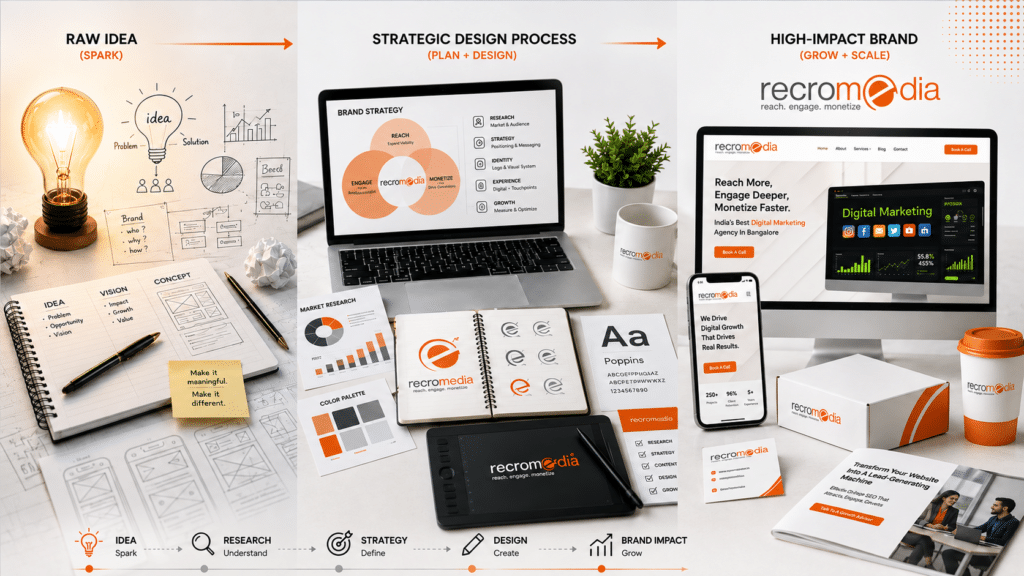
How Does Strategic Design Turn Ideas into High-Impact Brands?

Every business starts with an idea. But ideas, no matter how brilliant, don’t build brands on their own. What separates a forgettable business from one that people remember, trust, and return to is strategic design , the deliberate, research-backed process of shaping how a brand looks, feels, communicates, and behaves at every touchpoint. It’s not about making things pretty. It’s about making things work, and work in a way that consistently earns attention and loyalty. At Recromedia, a Digital Marketing Agency in Bangalore that works closely with startups and established businesses alike, we’ve seen firsthand how the right design strategy can take a good idea and turn it into a brand people actually seek out. This blog breaks down what strategic design really means, why it matters so much, and how it transforms raw ideas into brands with staying power. What Exactly Is Strategic Design? Strategic design is the practice of aligning every visual, verbal, and experiential element of a brand with a clear business purpose. It sits at the intersection of creativity and strategy , where a logo isn’t just a logo, it’s a decision informed by market positioning, and a website isn’t just a website; it’s a carefully mapped experience meant to guide a visitor toward action. Unlike traditional design, which often focuses purely on aesthetics, strategic design starts with questions: Who is this brand for? What does it need to communicate? What makes it different from everything else competing for the same customer’s attention? Only after those questions are answered does the actual creative work begin. This is why strategic design and strong Digital Marketing Services go hand in hand; one without the other tends to fall flat. Why Strategic Design Matters for Businesses In a market where customers are exposed to hundreds of brand messages a day, design is often the deciding factor in whether someone stops to pay attention or scrolls right past. A handful of reasons make this especially important today. First, first impressions happen fast, often within seconds of someone landing on a website or seeing a social post. Poor design signals a lack of credibility, even if the product or service behind it is excellent. Second, consistency builds trust. A brand that looks and sounds different across its website, packaging, and social channels creates confusion, while a brand with a unified identity feels dependable and established. Third, design directly impacts conversion. A well-structured website built by a skilled Web Development Company in Bangalore doesn’t just look good, it guides visitors naturally toward booking a call, making a purchase, or signing up. The Core Pillars of Strategic Design Strategic design isn’t a single deliverable, it’s a layered process built on several interconnected pillars. Brand Strategy Before any visual work begins, a clear brand strategy needs to exist. This includes defining the brand’s mission, values, target audience, positioning, and tone of voice. Without this foundation, design decisions become guesswork rather than informed choices. A brand that skips this step often ends up with a visual identity that looks nice but doesn’t actually connect with the people it’s trying to reach. Market Research Good design is never created in a vacuum. Understanding competitors, industry trends, and customer expectations shapes decisions in ways that pure creativity can’t. Market research reveals gaps a brand can fill and pitfalls it should avoid, whether that’s a color palette that’s overused in a particular industry or a messaging angle competitors haven’t claimed yet. This groundwork often overlaps with the kind of audience insight used in Search Engine Optimization Services, since both disciplines rely on genuinely understanding what a target customer is looking for. Visual Identity This is the most visible layer of strategic design , logo, color palette, typography, imagery style, and overall aesthetic. But a strong visual identity isn’t just about looking modern or trendy. It needs to be distinctive enough to be recognizable, flexible enough to work across formats, and aligned closely enough with the brand strategy that it actually communicates the right thing at a glance. User Experience (UX) A brand’s design extends far beyond how it looks, it includes how it feels to interact with. Whether someone is navigating a website, using a mobile app, or filling out a contact form, every interaction shapes their perception of the brand. This is where Mobile App Development Services in Bangalore becomes deeply tied to design strategy, since a clunky, confusing app can undo months of careful brand-building in a matter of seconds. Storytelling Customers rarely connect with facts and features alone, they connect with stories. Strategic design weaves a brand’s story into everything from its website copy to its social content, giving customers a reason to care beyond the product itself. A brand that can clearly articulate why it exists, and what it stands for, tends to build far deeper loyalty than one that only talks about what it sells. Customer Perception Ultimately, strategic design shapes how a brand is perceived, whether it feels premium or budget, trustworthy or questionable, modern or outdated. This perception directly influences buying decisions, often before a customer has even engaged with the product. It’s a slower, more subtle outcome than a click-through rate, but it’s arguably one of the most valuable assets a brand can build. Real-World Examples of Strategic Design in Action Some of the world’s most recognizable brands owe much of their success to disciplined, strategic design choices rather than product features alone. Airbnb, for example, rebuilt its entire brand identity around belonging and community rather than simply “renting a room,” a shift in storytelling and visual identity that helped it stand apart from traditional hotel booking platforms. Apple has long been recognized for using minimalist design and consistent visual language across every product and touchpoint to reinforce a premium, intuitive brand experience. Closer to home, many Indian D2C brands have grown rapidly not because their products were entirely unique, but because their packaging, website experience, and social presence were designed with a level of intentionality their competitors lacked.

Blog

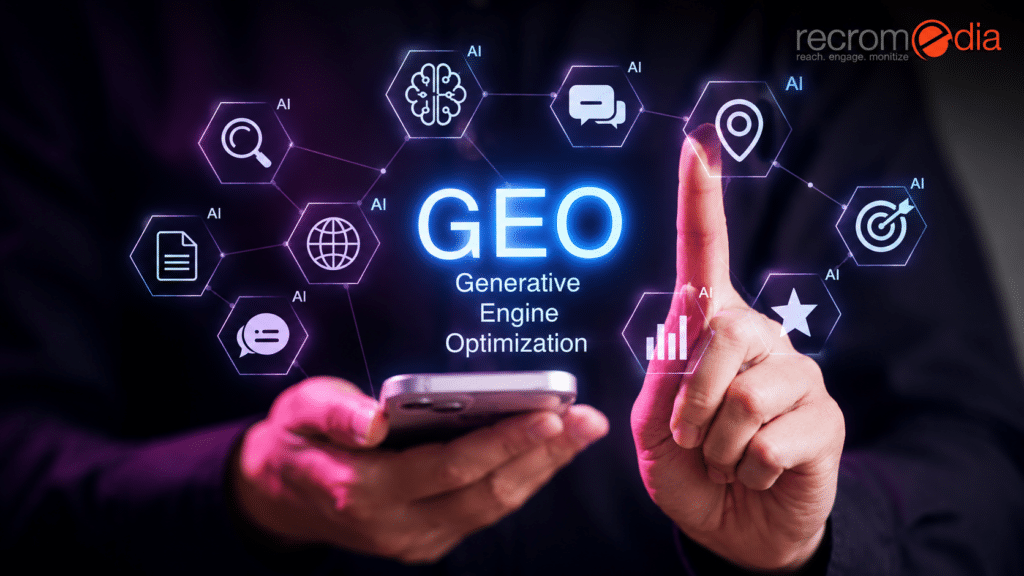
How Is Generative Engine Optimization (GEO) Shaping the Future of AI Search?

A year ago, most business owners had never heard the term “Generative Engine Optimization.” Today, it’s quickly becoming one of the most important conversations in digital marketing. As AI tools like ChatGPT, Google’s Gemini, Perplexity, and AI Overviews become a primary way people find information, the rules of visibility online are being rewritten. Ranking on Google is no longer the finish line , being cited, quoted, or referenced inside an AI-generated response is the new goal. That’s exactly what GEO is built for. At Recromedia, a Digital Marketing Agency in Bangalore working across industries, we’ve watched this shift closely because it directly affects how our clients get discovered. This blog explains what GEO actually is, how it works, how we apply it for clients at Recromedia, and why it’s becoming essential for any brand serious about staying visible in an AI-first search world. What Is Generative Engine Optimization (GEO)? Generative Engine Optimization is the process of optimizing content specifically so that generative AI tools , large language models that generate original, conversational answers , are more likely to pull from, cite, or reference that content when responding to a user’s prompt. Unlike traditional search engines that return a ranked list of links, generative engines synthesize information from multiple sources and produce a single, conversational answer. This means the competition isn’t just for a top ranking anymore. It’s for being one of the sources an AI model trusts enough to draw from when it builds its answer. A Best Digital Marketing Agency today has to think beyond keywords and rankings, and start thinking about how machine learning models interpret, weigh, and select content as credible input. GEO is closely related to AEO, but the two aren’t identical. AEO is largely about answering specific questions clearly for search and voice assistants. GEO is broader , it’s about how your content, brand mentions, and overall digital footprint influence what generative AI models learn and repeat about your business, often across many different queries and contexts, not just a single question. How Does GEO Actually Work? GEO operates on a different set of signals than classic SEO, though there’s meaningful overlap. Here’s what actually drives performance in this space. How Recromedia Implements GEO for Clients At Recromedia, GEO isn’t treated as a separate add-on service , it’s built into the broader strategy we run for every client, because it touches nearly every channel we manage. We begin by auditing how a client’s brand currently appears across the web: what’s being said about them, where they’re mentioned, and how consistent that information is. From there, we refine on-site content to be clearer, more original, and more fact-driven, while also working to strengthen off-site mentions through outreach, PR-style content, and credible third-party placements. Because GEO depends heavily on how a brand is discussed beyond its own website, our Social Media Marketing Company in Bangalore team plays a big role here. Consistent, active engagement on social platforms builds the kind of digital footprint that generative engines pick up on when forming an understanding of a brand’s authority and relevance. We also integrate GEO with our core Search Engine Optimization Services, since strong technical SEO , fast load times, clean site architecture, proper indexing , makes it easier for AI crawlers to access and understand content in the first place. A site that’s hard to crawl is a site that’s hard for any engine, generative or traditional, to trust. On the paid side, we combine this with online advertising agency strategies and continued investment in digital advertising agencies best practices, ensuring that while organic AI visibility builds over time, clients still maintain strong, immediate visibility through paid channels. We also apply GEO principles to Mobile App Design and app store content, since app descriptions and reviews are increasingly pulled into AI-generated answers about tools and services. Our Web Development Services in Bangalore team ensures every client site is technically sound enough to support this , because no amount of great content matters if the underlying site structure is holding it back from being properly read and understood by AI systems. How GEO Benefits Recromedia’s Clients The clients we’ve applied GEO strategy to are already seeing meaningful, measurable shifts in how they show up. The first benefit is expanded visibility. Instead of competing for one search results page, clients start appearing as cited sources across multiple AI platforms and conversational tools, reaching audiences at the exact moment they’re asking a question, often before they’ve even opened a traditional search engine. The second benefit is credibility. When a generative engine references a brand directly, it carries an implicit stamp of trust. Users tend to view AI-cited information as more reliable, which translates into stronger brand perception and a shorter path to conversion. The third benefit is compounding value. Unlike a single ranking that can shift with an algorithm update, a strong GEO presence , built through consistent mentions, quality content, and authority signals , tends to reinforce itself over time. It’s a long-term asset, similar to how a well-run Top SEO Agency in Bangalore partnership builds compounding organic value rather than a one-time spike. Finally, there’s the competitive advantage. Most businesses haven’t caught up to GEO yet. Clients who invest in it now, while it’s still relatively early, are positioning themselves well ahead of competitors who are still focused purely on traditional rankings. Where GEO Is Headed Generative AI search isn’t a passing trend , it’s becoming the default way many people find information, make decisions, and compare businesses. As models get better at understanding context, sourcing accurately, and personalizing answers, the brands that show up consistently, credibly, and clearly across the web will be the ones that get chosen as the answer, again and again. At Recromedia, we see GEO as the natural evolution of everything digital marketing has been working toward , building brands that are genuinely trustworthy, visible, and useful, wherever people are looking for answers. Whether that’s through smarter content, a stronger Best SEO Provider

Blog

Answer Engine Optimization (AEO): The Future Beyond SEO? 

For the last two decades, ranking on page one of Google has been the gold standard of digital success. Businesses poured budgets into keyword research, backlinks, and content calendars, all chasing that coveted blue link. But something has shifted quietly over the past couple of years. People aren’t just searching anymore, they’re asking. They’re typing full questions into ChatGPT, Google’s AI Overviews, Perplexity, and voice assistants, expecting a direct answer instead of ten links to click through. This shift has given rise to a new discipline that every business, especially those relying on a Digital Marketing Agency in Bangalore, needs to understand: Answer Engine Optimization, or AEO.  At Recromedia, we’ve spent the last year watching this transition happen in real time across client accounts, and we believe AEO isn’t a replacement for SEO; it’s the next layer built on top of it. This blog breaks down exactly what AEO is, how it works, how we implement it at Recromedia, and why it matters for your business right now.  What Exactly Is AEO?  Answer Engine Optimization is the practice of structuring and optimizing content so that AI-driven answer engines, like Google’s AI Overviews, ChatGPT, Bing Copilot, and voice assistants such as Siri or Alexa, can easily extract, understand, and present your content as a direct answer to a user’s query. Traditional SEO focuses on getting a webpage to rank in a list of search results. AEO focuses on getting your content chosen, summarized, and spoken or displayed as the answer itself, often without the user ever clicking through to your site.  This is a fundamental change in how visibility works. A Search Engine Optimization Services strategy that only aims for a top-ten ranking is no longer enough, because AI-generated answers now sit above or completely replace the traditional results list. If your content isn’t formatted in a way answer engines can parse and trust, you simply won’t be part of the conversation, no matter how good your rankings used to be.  How Does AEO Actually Work?  AEO relies on a mix of content clarity, technical structure, and authority signals. A few core mechanics drive it:  How Recromedia Implements AEO for Clients  At Recromedia, AEO isn’t a bolt-on service ,it’s woven into how we approach a client’s entire digital presence. Here’s what that looks like in practice.  We start with a content and technical audit, mapping out where a client’s existing pages already answer common customer questions and where there are gaps. From there, our team restructures key pages using clear question-and-answer formatting, adds schema markup, and rewrites sections so the most important answer appears immediately, not three paragraphs in.  Because AEO doesn’t work in isolation from the rest of a brand’s digital footprint, we pair it with the strategies we already run for clients ,including SEO Services Agency work to strengthen the technical foundation, and SEM Services in Bangalore campaigns to keep paid visibility strong while organic and AI-driven answer visibility catches up.  We also lean heavily on Social Media Marketing services in India, since answer engines increasingly pull context and authority signals from how a brand is discussed and referenced across platforms, not just from its own website. A brand that’s actively engaged, cited, and discussed online builds the kind of trust signal AI systems reward.  On the technical side, our Web Development Company in Bangalore team ensures that a client’s website architecture supports fast, clean crawling ,because no amount of great content will surface in an AI answer if the underlying site is slow, poorly coded, or hard to index. Similarly, we make sure Mobile App Development Services in Bangalore projects follow the same structured, answer-friendly principles, since voice assistants and AI tools frequently pull information from app content and metadata too.  Where relevant, we also fold in Online Advertising Campaigns and Geofencing in Bangalore tactics to keep local and hyper-targeted visibility strong, since AEO and traditional advertising now increasingly work side by side rather than as separate lanes.  The Benefits AEO Brings to Recromedia’s Clients  The businesses we work with are already seeing tangible advantages from this shift, and they tend to fall into a few categories.  First, there’s a visibility advantage. Clients who’ve restructured their content for AEO are starting to appear inside AI Overviews and chatbot answers for high-intent queries, putting their brand directly in front of a customer at the exact moment they’re deciding what to do next, often before a competitor’s traditional listing even appears.  Second, there’s a trust advantage. Being selected as “the answer” by an AI engine carries a credibility boost that a standard search listing doesn’t. Customers implicitly trust content that an AI system has chosen to surface, which translates into stronger brand perception even before someone visits the site.  Third, there’s efficiency. Because AEO content is inherently clearer, better structured, and more useful, it tends to perform better across the board, improving user experience, supporting better conversion rates, and making every other channel, from Advertising Services in Bangalore to email and social, work harder because the underlying messaging is sharper.  Finally, there’s future-proofing. Search behaviour is only going to keep moving toward conversational, AI-mediated discovery. Clients who adapt now, through structured AEO work alongside strong Best SEO Agency in Bangalore fundamentals, are positioning themselves ahead of competitors who are still treating this as a passing trend.  Is AEO Really the Future Beyond SEO?  Not exactly beyond ,more like alongside, and increasingly intertwined with it. SEO isn’t disappearing; it’s evolving. Answer engines still rely on many of the same signals that traditional search engines value: authority, relevance, technical health, and quality content. What’s changed is the format that wins, and the channels that matter. A business that ignores AEO today risks becoming invisible in the very place its future customers are starting to look for answers.  At Recromedia, we see AEO as a natural extension of everything digital marketing has always been about ,being useful, being clear, and showing up exactly where and when your audience needs you. Whether that’s

Blog

Types of SEO: A Comprehensive Guide for 2025

By Recromedia – Your Trusted SEO Services Agency and Digital Marketing Company in Bangalore Table of Contents What is SEO? SEO (Search Engine Optimization) is the process of optimizing your website to rank higher on search engine results pages (SERPs) for relevant keywords. The goal is to increase organic traffic by making your site more visible to users searching for products or services like yours. Recromedia, a leading SEO Services Agency and Top SEO Agency in Bangalore, helps Businesses improve their rankings through proven SEO strategies. SEO is not just about Keywords; it’s about delivering valuable content, a great user experience, and building trust-core principles of Google’s E-E-A-T framework. What Are the Different Types of SEO? SEO is a broad field with multiple specialized types, each targeting different aspects of website optimization. As a Best SEO Agency in Bangalore, Recromedia breaks down SEO into key categories: On-Page SEO, Off-Page SEO, Technical SEO, Local SEO, E-commerce SEO, YouTube SEO, International SEO, Mobile SEO, Voice SEO, and User Experience. Mastering each type allows your website to perform well across various search scenarios, improving visibility, traffic, and conversions. This guide will explore each type and its importance in a comprehensive SEO strategy. On-Page SEO On-Page SEO involves optimizing elements on your website to help search engines understand your content and rank it higher. This includes keyword research, optimizing titles, meta descriptions, header tags, internal linking, and ensuring content quality. Recromedia, a trusted SEO Company in Bangalore, ensures your pages are structured to serve both users and search engines effectively. On-Page SEO also includes optimizingimages with descriptive alt tags and creating URLs that are clean and keyword-rich. Proper on-page optimization improves relevance and user experience, two critical ranking signals. Off-Page SEO Off-Page SEO refers to activities outside your website that influence your rankings, primarily through backlinks from authoritative sites. Recromedia, a Top SEO Agency in Bangalore, uses ethical link-building strategies such as guest blogging, influencer outreach, and brand mentions to build your site’s authority. Social signals and online reviews also contribute to off-page SEO by enhancing your brand’s reputation. These external factors tell Google that your website is trustworthy and valuable, which can significantly boost rankings. Technical SEO Technical SEO ensures your website’s infrastructure allows search engines to crawl, index, and rank your site efficiently. This includes site speed optimization, mobile-friendliness, fixing crawl errors, and implementing structured data. Recromedia, a leading SEO Services In Bangalore, the provider conducts thorough technical audits to identify and fix issues that could hinder your site’s performance. Technical SEO also involves optimizing your robots.txt file and XML sitemaps to guide search engines. A technically sound website improves user experience and search visibility. Local SEO Local SEO focuses on optimizing your online presence to attract customers from specific geographic areas. For businesses targeting Bangalore or other cities, local SEO is crucial. Recromedia helps you optimize your Google My Business profile, manage local citations, and gather positive reviews to improve local rankings. This type of SEO ensures your business appears in “near me” searches and Google Maps results, driving foot traffic andlocal leads. E-commerce SEO E-commerce SEO optimizes online stores to increase visibility and sales. Recromedia enhances product pages, category pages, and site architecture to improve rankings. This includes keyword optimization, image SEO, user reviews, and fast loading times. Effective e- commerce SEO attracts targeted shoppers and reduces cart abandonment by improving site usability. YouTube SEO YouTube SEO optimizes video content to rank higher on YouTube and Google search results. Recromedia helps with keyword-rich titles, descriptions, tags, engaging thumbnails, and encouraging viewer interaction. Since YouTube is the second-largest search engine, optimizing videos can significantly boost brand visibility and engagement. International SEO International SEO targets global audiences by optimizing websites for multiple countries and languages. Recromedia assists clients in implementing hreflang tags, localized content, and geo-targeting strategies to improve rankings worldwide. This ensures your website meets cultural and language preferences, expanding your reach effectively. Mobile SEO Mobile SEO ensures your website performs well on smartphones and tablets. With Google’s mobile-first indexing, the mobile version of your site is prioritized in rankings. Recromedia designs responsive websites with fast load times and easy navigation on mobile devices, improving rankings and user experience. Voice SEO Voice SEO adapts your content for voice search queries, which tend to be more conversational and question-based. Recromedia optimizes for featured snippets and natural language keywords to capture voice search traffic, aligning with the rise of virtual assistants like Siri and Google Assistant. User Experience User experience has become a critical ranking factor as Google increasingly values how users interact with your website. Metrics such as page load speed, mobile responsiveness, ease of navigation, and visual stability all contribute to a positive experience. Recromedia, a trusted SEO Services Agency, ensures your website excels in these areas by optimizing Core Web Vitals like Largest Contentful Paint (LCP), First Input Delay (FID), and Cumulative Layout Shift (CLS). A smooth user experience keeps visitors engaged longer, reduces bounce rates, and signals to Google that your site is valuable and trustworthy. By combining technical SEO with user-centric design, Recromedia helps businesses improve rankings while delivering exceptional experiences to their customers. Why Choose Recromedia? Choosing the right SEO partner is crucial for your business’s online growth. Recromedia combines deep expertise, a commitment to ethical SEO, and a focus on E-E-A-T principles to deliver sustainable results. As a Top SEO Agency in Bangalore and a respected digital marketing company, we tailor strategies to your unique business needs. Our transparent communication, ongoing optimization, and data-driven approach ensure your website not only ranks higher but also builds lasting trust with your audience. Partner with Recromedia for comprehensive SEO Services In Bangalore and watch your online presence grow. FAQ’s What is SEO?SEO is the process of optimising your website to improve its visibility and attract organic traffic traffic from search engines.How many types of SEO are there?There are many types, including On-Page, Off-Page, Technical, Local, E-commerce, YouTube, International, Mobile, Voice, and User Experience SEO.Why is User Experience important for SEO?Because

Scroll to Top