
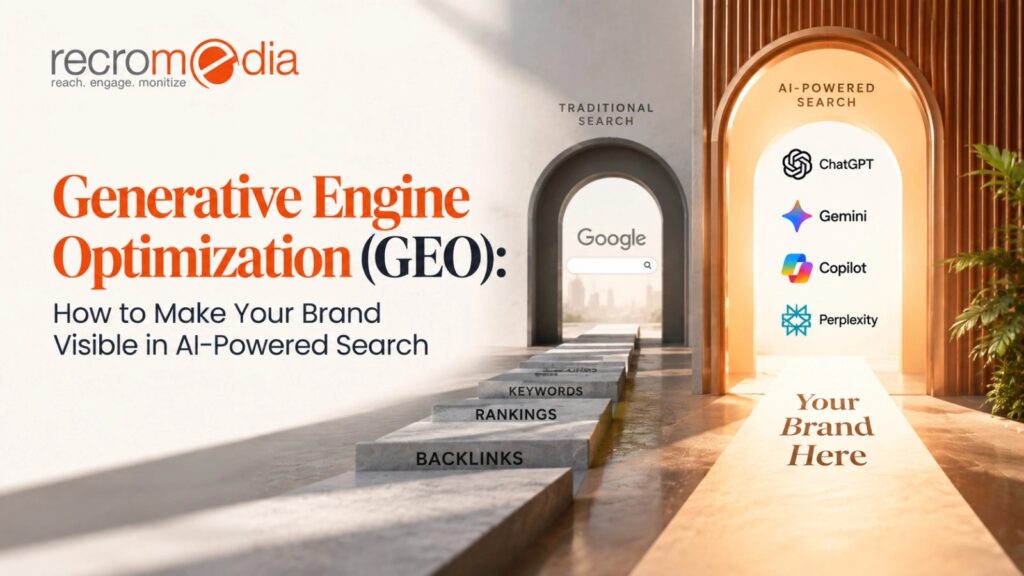
Search is changing from a system that simply finds webpages into an experience that can synthesise information and provide users with direct answers.
Google’s AI Overviews and AI Mode are examples of this shift. In May 2026, Google also published dedicated guidance on optimising for generative AI features in Search, including guidance around content quality, local information, images, video and common misconceptions about AEO and GEO.
This has made Generative Engine Optimization (GEO) an increasingly discussed concept among businesses and marketers.
But GEO should not be treated as a magic formula for getting a brand mentioned by AI systems. There is no guaranteed method for making a particular business appear in an AI-generated response.
The more useful approach is to understand how search is evolving and make your brand’s information genuinely useful, accessible, clear and trustworthy.
What Is Generative Engine Optimization?
GEO is commonly used to describe efforts aimed at improving a brand’s visibility within generative or AI-powered search experiences.
Unlike conventional search, where a user may receive a list of webpages, generative search experiences can synthesise information from multiple sources to construct an answer.
For businesses, this changes the question from:
“How do I rank for this keyword?”
to a broader question:
“How can my brand become a useful and credible source when people search for information related to what I offer?”
That does not mean abandoning traditional SEO.
In fact, Google’s current guidance explicitly states that SEO best practices continue to be relevant to its generative AI features.
GEO Is Not a Replacement for SEO
One of the biggest misconceptions around GEO is that businesses need an entirely separate set of technical tricks to appear in AI-powered search.Google’s current documentation does not support that idea.
Instead, its guidance emphasises established fundamentals: creating useful content, ensuring pages can be crawled and indexed, providing relevant information and avoiding practices designed primarily to manipulate search systems.
This means a strong Search Engine Optimization Services strategy can provide an important foundation for visibility in evolving search experiences.
GEO should therefore be viewed as an extension of a broader search and content strategy, not a replacement for it.
Create Information AI Systems Can Understand
A brand cannot be meaningfully understood if its information is unclear or inconsistent.Businesses should make important information easy to find across their digital presence.
That can include:
- Clear descriptions of products and services
- Well-structured website content
- Accurate company information
- Detailed service pages
- Authoritative educational content
- Relevant supporting resources
- Consistent terminology
- Useful answers to customer questions
The goal is not to write content specifically for machines.It is to make the information useful for people while presenting it in a structure that search systems can understand.
Go Beyond Generic Content
This is where many businesses can make a meaningful difference.If a website simply repeats information that can be found on hundreds of other pages, it gives users and search systems, little reason to consider it distinctive.Google’s current generative-AI guidance specifically highlights the importance of non-commodity content: information that provides genuine value instead of simply reproducing existing material.
For a business, that could mean sharing:
- Original expertise
- Detailed explanations
- First-hand experience
- Useful comparisons
- Industry-specific insights
- Practical examples
- Clear answers to complex questions
The objective is not more content.It is more useful content.
Build a Strong Information Ecosystem
One article rarely establishes a brand as an authority on an entire subject.
A stronger approach is to build connected content around the areas in which the business has genuine expertise.
For example, a digital marketing company could create resources covering SEO, paid advertising, content strategy, social media, conversion optimisation and changing search behaviour.
These pages can be connected through relevant internal links, creating a coherent information ecosystem.This also gives the website more opportunities to answer different types of questions rather than relying on one page to do everything.
Make Your Brand’s Entity Information Clear
AI-powered search is not only about individual articles.A business also needs a clear digital identity.
Its website should make fundamental information easy to understand: what the business does, which services it provides, where it operates and what expertise it represents.
Structured data can help Google understand certain types of information on webpages. However, Google does not guarantee that implementing structured data will result in a particular search appearance.That distinction is important.Structured data can support understanding; it is not a guarantee of visibility.
Don’t Ignore Images, Video and Local Information
Generative search is not restricted to text.Google’s current guidance specifically discusses providing local, shopping, image and video content where relevant.For businesses, this means their digital presence should reflect the way customers actually research products and services.
A restaurant, for example, may benefit from useful local information and visual content. A fashion brand may need strong product imagery and video. A service business may need detailed explanations, examples and location information.The right formats depend on the business and its audience.
Avoid Chasing Artificial AI Visibility
There is a temptation to create content specifically designed to manipulate AI-generated answers.That is a risky direction.
Google’s spam policies apply to generative AI responses as well as conventional Search. Its policies specifically address scaled content created primarily to manipulate search rankings rather than help users.This is another reason quality matters more than volume.
Publishing hundreds of shallow pages will not automatically make a brand more visible in AI-powered search.
How RecroMedia Approaches GEO
At RecroMedia, GEO is best approached as part of a wider search strategy.
The focus should begin with understanding what the audience wants to know, how that information is being searched for and whether the brand has created genuinely useful resources around those needs.That means bringing together content strategy, website optimisation, search intent and SEO Services Agency expertise rather than treating GEO as an isolated technical exercise.
The objective is not to promise that a brand will appear in every AI-generated answer.It is to build a stronger digital information footprint that gives search systems more useful, accurate and relevant information about the brand.
The Real Goal of GEO
The rise of AI-powered search does not make traditional SEO irrelevant.It makes useful information even more important.Businesses that want to remain discoverable should focus on building expertise, answering real questions, maintaining accurate information and creating content that provides genuine value.
There is no guaranteed GEO shortcut.But there is a more sustainable strategy: become a brand that has something useful to say, make that information easy to understand, and build a digital presence that consistently demonstrates what you know.That is the foundation on which RecroMedia approaches the changing search landscape.
Frequently Asked Questions
1. What is Generative Engine Optimization (GEO)?
A: Generative Engine Optimization (GEO) refers broadly to efforts aimed at improving a brand’s visibility in generative and AI-powered search experiences. Instead of focusing only on ranking for individual keywords, GEO considers how a brand can become a useful, clear and credible source when AI-powered systems generate answers related to its products, services or expertise.
2. Is GEO a replacement for traditional SEO?
A: No. GEO should not be treated as a replacement for SEO. Google’s guidance states that established SEO best practices remain relevant to its generative AI features. RecroMedia approaches GEO as an extension of a broader search strategy, combining Search Engine Optimization Services, useful content, website optimisation and search-intent understanding.
3. How can businesses improve their visibility in AI-powered search?
A: Businesses can strengthen their digital information footprint by providing clear and accurate information about their products, services, expertise and locations. Creating useful, non-commodity content, maintaining a technically accessible website and presenting relevant information across appropriate formats can all support a stronger digital presence. RecroMedia focuses on these fundamentals rather than promising a guaranteed method for appearing in AI-generated answers.
4. Does creating more content improve GEO visibility?
A: Not necessarily. The quality and usefulness of content are more important than simply increasing content volume. Google’s guidance highlights the value of non-commodity content that provides genuine value rather than reproducing information already available elsewhere. RecroMedia’s approach focuses on developing useful resources around genuine areas of business expertise instead of producing large volumes of shallow content.
5. How does RecroMedia approach GEO for businesses?
A: RecroMedia treats GEO as part of a wider search and content strategy. The approach begins by understanding what audiences want to know and how they search for that information, then focuses on content quality, website optimisation, search intent and clear brand information. The objective is to build a stronger, more useful digital information ecosystem rather than claim guaranteed visibility in every AI-powered search experience.