
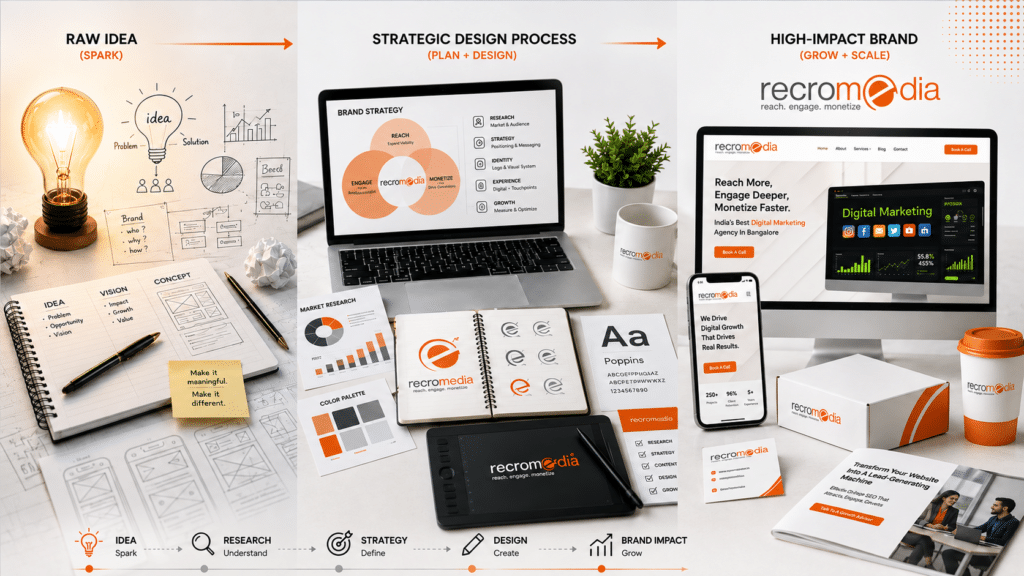
Every business starts with an idea. But ideas, no matter how brilliant, don’t build brands on their own. What separates a forgettable business from one that people remember, trust, and return to is strategic design , the deliberate, research-backed process of shaping how a brand looks, feels, communicates, and behaves at every touchpoint. It’s not about making things pretty. It’s about making things work, and work in a way that consistently earns attention and loyalty.
At Recromedia, a Digital Marketing Agency in Bangalore that works closely with startups and established businesses alike, we’ve seen firsthand how the right design strategy can take a good idea and turn it into a brand people actually seek out. This blog breaks down what strategic design really means, why it matters so much, and how it transforms raw ideas into brands with staying power.
What Exactly Is Strategic Design?
Strategic design is the practice of aligning every visual, verbal, and experiential element of a brand with a clear business purpose. It sits at the intersection of creativity and strategy , where a logo isn’t just a logo, it’s a decision informed by market positioning, and a website isn’t just a website; it’s a carefully mapped experience meant to guide a visitor toward action.
Unlike traditional design, which often focuses purely on aesthetics, strategic design starts with questions: Who is this brand for? What does it need to communicate? What makes it different from everything else competing for the same customer’s attention? Only after those questions are answered does the actual creative work begin. This is why strategic design and strong Digital Marketing Services go hand in hand; one without the other tends to fall flat.
Why Strategic Design Matters for Businesses
In a market where customers are exposed to hundreds of brand messages a day, design is often the deciding factor in whether someone stops to pay attention or scrolls right past. A handful of reasons make this especially important today.
First, first impressions happen fast, often within seconds of someone landing on a website or seeing a social post. Poor design signals a lack of credibility, even if the product or service behind it is excellent. Second, consistency builds trust. A brand that looks and sounds different across its website, packaging, and social channels creates confusion, while a brand with a unified identity feels dependable and established. Third, design directly impacts conversion. A well-structured website built by a skilled Web Development Company in Bangalore doesn’t just look good, it guides visitors naturally toward booking a call, making a purchase, or signing up.
The Core Pillars of Strategic Design
Strategic design isn’t a single deliverable, it’s a layered process built on several interconnected pillars.
Brand Strategy
Before any visual work begins, a clear brand strategy needs to exist. This includes defining the brand’s mission, values, target audience, positioning, and tone of voice. Without this foundation, design decisions become guesswork rather than informed choices. A brand that skips this step often ends up with a visual identity that looks nice but doesn’t actually connect with the people it’s trying to reach.
Market Research
Good design is never created in a vacuum. Understanding competitors, industry trends, and customer expectations shapes decisions in ways that pure creativity can’t. Market research reveals gaps a brand can fill and pitfalls it should avoid, whether that’s a color palette that’s overused in a particular industry or a messaging angle competitors haven’t claimed yet. This groundwork often overlaps with the kind of audience insight used in Search Engine Optimization Services, since both disciplines rely on genuinely understanding what a target customer is looking for.
Visual Identity
This is the most visible layer of strategic design , logo, color palette, typography, imagery style, and overall aesthetic. But a strong visual identity isn’t just about looking modern or trendy. It needs to be distinctive enough to be recognizable, flexible enough to work across formats, and aligned closely enough with the brand strategy that it actually communicates the right thing at a glance.
User Experience (UX)
A brand’s design extends far beyond how it looks, it includes how it feels to interact with. Whether someone is navigating a website, using a mobile app, or filling out a contact form, every interaction shapes their perception of the brand. This is where Mobile App Development Services in Bangalore becomes deeply tied to design strategy, since a clunky, confusing app can undo months of careful brand-building in a matter of seconds.
Storytelling
Customers rarely connect with facts and features alone, they connect with stories. Strategic design weaves a brand’s story into everything from its website copy to its social content, giving customers a reason to care beyond the product itself. A brand that can clearly articulate why it exists, and what it stands for, tends to build far deeper loyalty than one that only talks about what it sells.
Customer Perception
Ultimately, strategic design shapes how a brand is perceived, whether it feels premium or budget, trustworthy or questionable, modern or outdated. This perception directly influences buying decisions, often before a customer has even engaged with the product. It’s a slower, more subtle outcome than a click-through rate, but it’s arguably one of the most valuable assets a brand can build.
Real-World Examples of Strategic Design in Action
Some of the world’s most recognizable brands owe much of their success to disciplined, strategic design choices rather than product features alone. Airbnb, for example, rebuilt its entire brand identity around belonging and community rather than simply “renting a room,” a shift in storytelling and visual identity that helped it stand apart from traditional hotel booking platforms. Apple has long been recognized for using minimalist design and consistent visual language across every product and touchpoint to reinforce a premium, intuitive brand experience. Closer to home, many Indian D2C brands have grown rapidly not because their products were entirely unique, but because their packaging, website experience, and social presence were designed with a level of intentionality their competitors lacked.
Practical Design Tips for Startups
Startups often assume strategic design is only worth investing in once they’ve scaled, but the opposite tends to be true. A few practical starting points can make a significant difference early on.
Start with a clear brand strategy document before touching any visuals, even a simple one outlining audience, tone, and positioning. Invest in a professional logo and consistent color palette rather than relying on generic templates that dozens of other businesses are also using. Prioritize a clean, fast, mobile-friendly website, since a large share of first impressions now happen on a phone screen. Keep messaging consistent across every platform, from your website to your Social Media Marketing services in India presence, so customers see the same brand personality everywhere they encounter it. Finally, don’t treat design as a one-time project, revisit and refine it as the business grows and audience needs evolve.
How Recromedia Approaches Strategic Design for Clients
At Recromedia, we treat design as a strategic function, not a final polish added at the end of a project. Every engagement starts with research and positioning work before any visual direction is proposed, ensuring that design decisions are grounded in what a client’s actual audience responds to.
From there, our team builds out visual identity systems, website experiences through our Web Development Services in Bangalore work, and app interfaces through Mobile App Design, all built to work together as one cohesive brand rather than disconnected pieces. We also make sure design decisions support broader goals like Advertising Services in Bangalore campaigns and organic growth through a strong SEO Company in Bangalore partnership, since a beautifully designed brand still needs the right strategy behind it to actually reach its audience.
Long-Term Brand Growth Through Design
Strategic design isn’t a one-time investment, it compounds over time. A well-designed brand becomes easier to market, easier to advertise, and easier for customers to recommend to others. It reduces the friction in every campaign that follows, because the foundation is already doing part of the work. Businesses that treat design as an ongoing strategic priority, rather than a box to check early on, tend to build far more resilient, recognizable brands over the long run.
Key Takeaways
Strategic design is what separates a good idea from a lasting brand. It requires clear brand strategy, real market research, a distinctive visual identity, thoughtful user experience, authentic storytelling, and a genuine understanding of customer perception. The businesses that invest in this early, and treat it as an ongoing priority rather than a one-time task, are the ones that build brands people remember and trust.
At Recromedia, we believe great design and great strategy shouldn’t be separate conversations, they should be the same one. If you’re ready to turn your idea into a brand with real staying power, we’d love to help you build it right from the start. Reach out to Recromedia, and let’s design something worth remembering.